

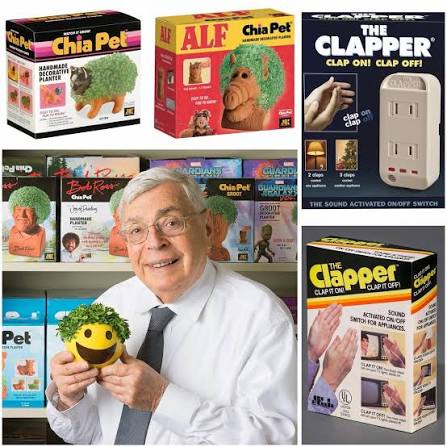
Joseph Pedott was walking the floor of a housewares convention at Chicago’s McCormick Place in 1977 when a Thrifty Drug buyer pointed him toward a ceramic ram that sprouted green fuzz from seeded grooves, calling it “the most stupid thing” on the show floor — and also one of the store’s best sellers, according to the San Francisco Standard. Pedott, a San Francisco advertising man who had grown up in hardship in Chicago, took over the account, then bought the whole brand. Eight years later he did it again with a sound-activated light switch nobody could sell. By the time he died in 2023 at 91, both novelties had become punchlines every American of a certain age could finish unprompted.
A Chicago Kid Who Sold Ads Before He Sold Anything Else
Pedott’s early life gave no hint of the empire ahead. He contracted rheumatic fever at 11, lost his mother while she was hospitalized, and left an abusive father’s home at 16 to live at a Chicago YMCA, according to the San Francisco Standard. A local social services organization, SGA Youth & Family Services, helped see him through those years. He went on to earn a journalism degree from the University of Illinois Urbana-Champaign in 1955, having already co-founded an advertising agency with a college friend and commuted between campus and the Chicago office on weekends, according to the Chicago Sun-Times. He relocated to San Francisco in 1958 and built his own agency there, writing an estimated 2,000 commercials over the following decades, according to the Washington Post. Nothing in that résumé pointed toward ceramic livestock. What he had instead was an ear for a phrase that would survive repetition, which turned out to matter more than the product itself.
Ch-Ch-Ch-Chia
The Post reports that Pedott purchased the Chia figurine’s rights from its original creator, Walter Houston, for $25,000, then cut out a Mexican middleman and relaunched the line through his own company, Joseph Enterprises. The first mass-market animal, a ram, reached television screens in 1982. The jingle that made it inescapable — “Ch-Ch-Ch-Chia” — came out of an off-the-cuff stutter that a friend or colleague delivered as a joke, and Pedott recognized it instantly as the ad, according to the Washington Post. U.S. sales of the sprouting planters eventually topped 25 million units, spanning designs from a Homer Simpson bust to Baby Yoda to a sitting president, according to the Chicago Sun-Times.
Clap On, Clap Off
In 1985, Pedott acquired a struggling sound-activated switch that had been marketed under the name “The Great American Turn-On,” redesigned it, and renamed it the Clapper, according to the San Francisco Standard. The “clap on, clap off” jingle became so embedded in American households that Pedott later estimated ninety percent of the public could identify both of his brands on sight, per the same report. He held his ground on the name even when dinner-party guests snickered at its double meaning, telling skeptics that the joke said more about them than about the product, according to the Washington Post. Between the two novelties, Joseph Enterprises had turned two ideas other companies had already given up on into permanent fixtures of American gag-gift culture. Pedott also went on to market the Garden Weasel tilling tool and the ‘Ove’ Glove oven mitt through the same company, according to the Washington Post, applying the same late-night-television formula each time: a plain product, a repeatable line, and enough airtime to make it stick.
What He Did With the Money
Pedott sold Joseph Enterprises and his advertising agency in 2018 to Joel Weinshanker, president of the National Entertainment Collectibles Association, but kept working into January 2023, five months before his death, according to the San Francisco Standard. He funneled a substantial share of his fortune into a nonprofit that grew to more than $10 million in assets, directing money toward first-generation college students through Mission Graduates and ScholarMatch and back toward SGA Youth & Family Services, the organization that had helped him as a teenager, per the same reporting. He also gave to Jewish student life at UC Davis, once donating an entire $25,000 commission to the cause in 1967. None of it was announced with a jingle. A man who built his career convincing strangers to buy things they didn’t need spent his last years quietly making sure kids who’d had it as rough as he once did got what they actually did — and made sure almost nobody heard about it until his obituary ran.

Leave a Reply