

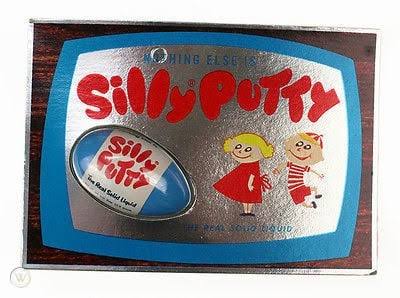
In 1943, General Electric engineer James Wright dropped boric acid into silicone oil inside a wartime research lab and produced a compound that failed at the one job it was built for. The U.S. had lost access to Asian rubber plantations after Japan’s advance through the Pacific, and GE was one of several manufacturers racing to build a synthetic substitute strong enough for tires, gaskets, and boots. Wright’s gunk bounced twenty-five percent higher than real rubber and resisted rot, according to the Strong National Museum of Play, but it also drooped into a puddle if left alone and shattered under a hammer. It could not hold a shape, so the Army had no use for it. Seven years later, it became one of the best-selling toys in American history.
A Government Contract Nobody Could Solve
Wright’s employer had taken on the rubber problem directly, having accepted a government contract to develop an affordable substitute during the war, according to the Science History Institute. Wright’s approach was to swap silicon for the carbon atoms that give natural rubber its structure. He filed a patent application on the resulting compound in 1944, according to Carnegie Mellon University, but no manufacturer, including GE itself, found a practical application for a rubber that couldn’t hold together. Chemists and engineers around the country passed samples of the stuff at parties for years afterward, where it earned nicknames like “nutty putty” and “bouncing putty” long before it had a real one.
A Toy-Shop Owner Sees What GE Couldn’t
By 1949, the putty had drifted to a Connecticut toy store owned by Ruth Fallgatter, who showed it to an advertising consultant named Peter Hodgson. Hodgson bought the production rights and a batch of the compound from GE’s lab, according to the Science History Institute, then did what GE’s engineers never had reason to try: he packaged it as an object of pure amusement rather than an industrial material. He hired Yale students to portion one-ounce blobs into plastic eggs, priced them at a dollar apiece, and timed the release for Easter 1950, according to the Strong National Museum of Play. He renamed the product Silly Putty for the shelf.
The New Yorker Notices, and Orders Explode
Sales were modest until a reporter for The New Yorker spotted the putty-filled eggs at a Doubleday bookstore and wrote it up in August 1950. Orders topped 250,000 in three days after the piece ran, according to the TIME retrospective on the toy, a volume Hodgson’s small operation had no way to anticipate. Within a year he had sold millions of eggs, and annual sales later climbed past $5 million during the 1970s, according to the Science History Institute. Hodgson had turned a substance the Army rejected into a product that needed no instructions, no batteries, and almost no manufacturing overhead beyond the eggs themselves.
From a Failed War Material to a Space Tool
The same properties that made Wright’s compound useless for tires eventually made it useful somewhere else entirely: NASA packed Silly Putty aboard the Apollo 8 mission so astronauts could use it to anchor loose tools in zero gravity, according to TIME. A material that oozed rather than held its shape under sustained pressure, and that had been dismissed as too unstable for gaskets or seals, turned out to be exactly stable enough to keep a wrench from drifting off in orbit. Kids meanwhile discovered they could press the putty onto a newspaper comic strip and peel the ink clean off, stretching Dick Tracy’s face into something unrecognizable — a party trick Wright’s lab notes never anticipated either.
A Toy With No Blueprint
Silly Putty went on to add new colors in 1990 and a glow-in-the-dark version in 1991, decades after Wright had moved on from the project entirely. The Strong inducted it into the National Toy Hall of Fame in 2001, according to the Strong National Museum of Play, permanently filing a failed military material under childhood nostalgia instead of wartime industry. Wright, who died in 1976, spent thirty-five years at GE generating patents across chemistry and metallurgy, and nothing in that record suggests he set out to entertain anyone. The putty’s real invention wasn’t chemical. It was Hodgson’s decision to stop asking what the compound was for and start asking what somebody might do with it for fun — a question GE’s rubber program, bound to a military deadline, was never allowed to sit with long enough to answer.

Leave a Reply