

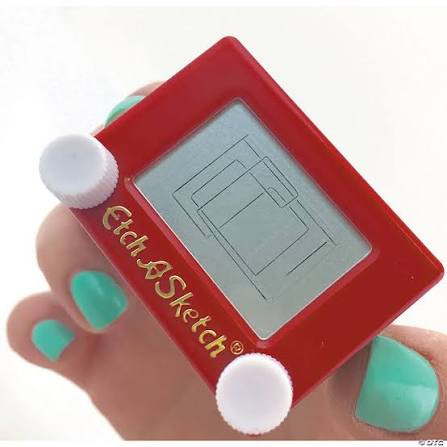
André Cassagnes was installing a light-switch plate at a French factory when he noticed something strange: pencil marks he’d made on a sheet of translucent decal were transferring cleanly to the surface underneath it. The factory produced aluminum-powder coatings for picture frames, and Cassagnes, an electrician by trade, realized the combination of metallic powder and static electricity could let someone draw and erase on glass indefinitely. He built a prototype, showed it at a European toy fair, and by the time he died in 2013, the resulting toy had sold 175 million units worldwide, according to Smithsonian Magazine’s history of the toy’s 60th anniversary.
An Electrician’s Accident
Cassagnes was born outside Paris to a family that ran a bakery; a flour allergy pushed him out of the family business and into electrical work instead, according to Wikipedia’s sourced biography of Cassagnes. He was working for Lincrusta, a company specializing in aluminum-powder coatings, when the light-switch discovery happened sometime in the 1950s. He refined the effect into a hand-built prototype using a joystick to move a stylus beneath a glass screen, calling it “L’Ecran Magique” — “the magic screen” — per CNN’s report on his death.
A Toy Fair Discovery
Cassagnes debuted his invention at the 1959 International Toy Fair in Nuremberg, West Germany. Ohio Art Company, an American toy manufacturer based in Bryan, Ohio, showed no real interest at first, but reconsidered after a second look, according to Wikipedia’s account of the licensing process. The company’s founder, Henry Winzeler, agreed to pay $25,000 for the rights — more than Ohio Art had ever spent on a toy license before, equal to roughly $272,000 today, per Smithsonian’s reporting. Ohio Art renamed it Etch A Sketch and launched it for the 1960 Christmas season, priced at $2.99.
An Immediate American Hit
The gamble paid off fast. Etch A Sketch sold 600,000 units in its first year alone, according to Smithsonian’s account of Ohio Art’s 1960 sales figures. Production settled into a precise, largely manual process at the company’s Bryan, Ohio plant, where workers — some staying on the same assembly line for more than four decades — maintained tight tolerances on the glass and the purified aluminum powder inside each unit, per the same reporting. The toy went on to earn a spot in the National Toy Hall of Fame in 1998 and was named one of the 100 most memorable toys of the 20th century by the Toy Industry Association in 2003, according to Wikipedia’s history of the toy.
A Second Career in Kites
Cassagnes didn’t stay in the toy business. He went on to become one of France’s best-known kite designers, described in a 1992 issue of Kite Lines as “the most famous kitemaker in France,” according to Wikipedia’s biography. He built ring-shaped kites used in Olympic Games celebrations and continued inventing mechanical toys, including devices called the Teleguide and SkeDoodle, for years afterward. He died on January 16, 2013, at 86 years old in a Paris suburb, survived by his wife, Renee, and their three children, per CNN’s obituary coverage. Ohio Art, which was still manufacturing the toy in Bryan, Ohio at the time of his death, credited his invention with having “brought joy to so many over such a long period of time,” according to NBC News’ report on his death.
Bigger Than the Toy Aisle
The Etch A Sketch outgrew its own category more than once. Ohio Art released a color version in 1993, decades after the original black-and-white screen debuted, and later added digital versions for phones and tablets, per NBC News’ reporting. The toy turned up repeatedly in pop culture, including recurring appearances in the Toy Story films, and briefly became a piece of national political shorthand in 2012 when a Mitt Romney campaign aide compared the candidate’s shifting positions to shaking an Etch A Sketch clean, a moment NBC News’ report also references. The Toy Industry Association later placed it on its list marking a century of significant American toys, cementing a status Cassagnes never chased for himself — his own second act was spent building kites, not managing the royalties from the toy that made his name.
An Accident That Outlived Its Inventor
Ohio Art’s design has changed remarkably little since 1960 — the same two knobs, the same gray screen, the same shake-to-erase reset that Cassagnes never patented in a way that made him rich. What he found on a factory floor by accident became one of the most recognized toy shapes of the twentieth century, and 175 million units later, it’s still sold in something close to its original form, a rare thing for any product built before color television was common in American homes.

Leave a Reply