

The lava lamp turns 63 this year. British accountant-turned-inventor Edward Craven Walker launched the original “Astro” lamp in the UK in 1963 with his wife, Christine, selling early units out of a converted postal van nicknamed Smokey, according to the company’s own Mathmos Timeline. More than six decades later, Mathmos — the company Craven Walker founded — is still manufacturing lava lamps out of a factory in Poole, Dorset, and the design he patented is still, largely, the same product being sold in shopping malls today.
A formula that’s stayed a secret for 63 years
Per Mathmos’s own company history, the wax-and-liquid formula that makes the lamp’s slow-moving blobs rise and fall remains “a strict trade secret” today, the same as it was in 1963. That’s a genuinely unusual claim for a mid-century consumer product — most 1960s gadgets have been reverse-engineered or superseded generations ago. Mathmos reports it has sold more than four million lamps across its history, and the company marked its 60th anniversary in 2023 with new product releases rather than a retrospective-only campaign, which is its own signal: this isn’t a company coasting on nostalgia for a product it stopped meaningfully developing.
How it became a cultural fixture, not just a lamp
The lamp’s cultural footprint was established fast. UK retailers Selfridges and Habitat began stocking it within a year of launch, in 1964. By the mid-to-late 1960s it was appearing on television, including in Doctor Who and The Prisoner, and by the end of the decade it had picked up rock-and-roll association: Ringo Starr bought an Astro lamp in 1969, and David Bowie was photographed with one in his recording studio in 1971. That run of appearances across a five-to-eight-year span is what actually built the lamp’s identity as a symbol of the psychedelic and counterculture era, rather than a single celebrity endorsement or one well-timed TV placement.

What actually happens inside the lamp
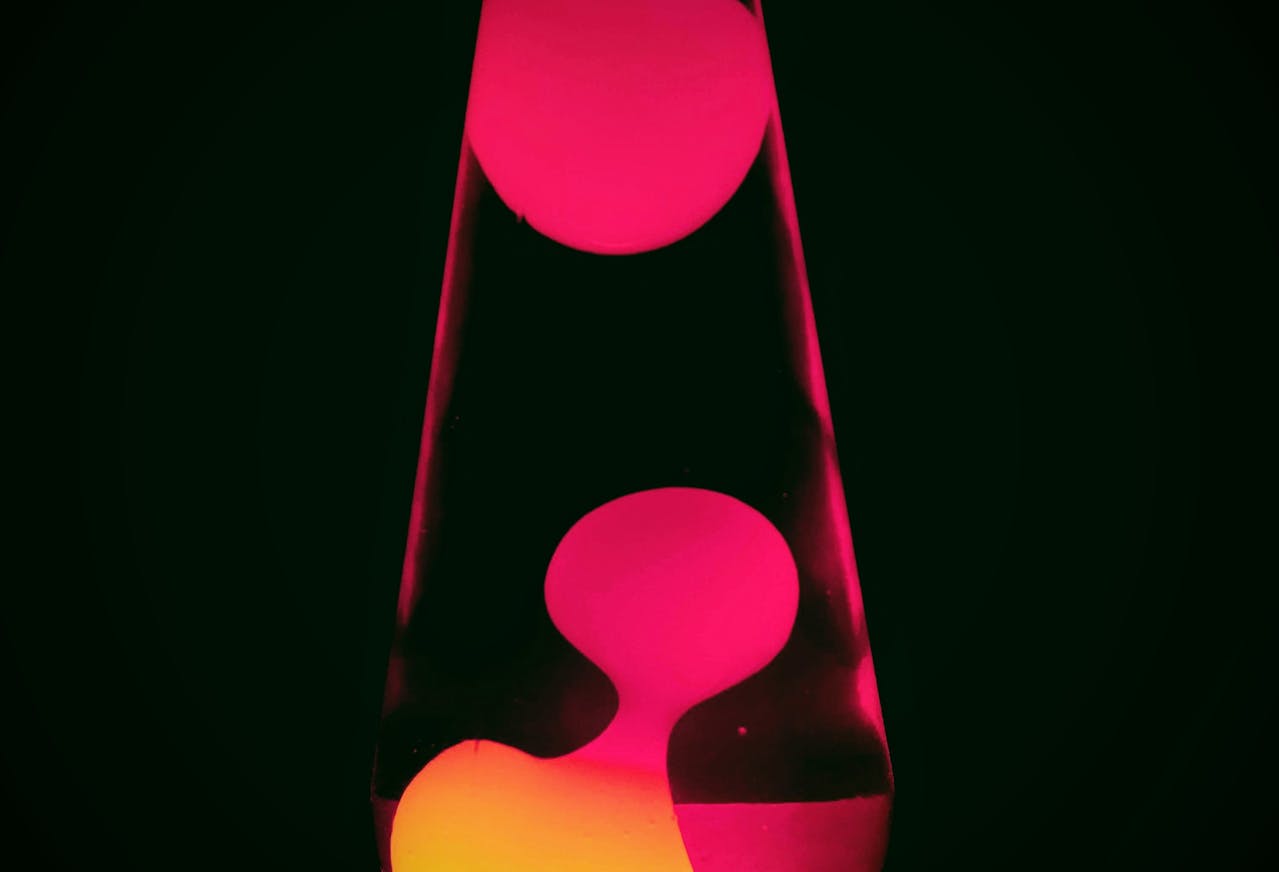
The mechanism is simpler to describe than the formula behind it is to replicate: a wax-based compound sits at the bottom of a glass vessel filled with a clear liquid, and a standard incandescent bulb beneath the vessel heats the wax until it becomes slightly less dense than the surrounding liquid, causing it to rise. As it rises away from the heat source, it cools, becomes denser again, and sinks back down, repeating the cycle for as long as the lamp stays on. That basic physics has been public knowledge for decades — heat, density, and buoyancy aren’t proprietary concepts — which is exactly why Mathmos’s insistence on keeping its specific wax-and-liquid formula a trade secret is notable. Plenty of manufacturers have built lamps using the same general principle since the 1960s patent expired, but Mathmos’s original formulation is still the one collectors and enthusiasts treat as the reference standard for how the motion is supposed to look.
It never actually left mainstream retail
Unlike a lot of 1960s design objects that cycle in and out of availability, the lava lamp has stayed in continuous mainstream retail distribution. It’s currently stocked in Walmart’s lava lamp category, alongside brand-specific listings from Urban Shop and other manufacturers. Urban Outfitters carries its own version — at $26, the listing recently sold out and moved to a waitlist rather than being discontinued, which is a more useful demand signal than a price point alone. A product that a mall retailer keeps selling out of, six decades after its invention, isn’t surviving on collector nostalgia; it’s still functioning as an ordinary, repeat-purchase home good.
That combination — a still-secret original formula, a company still manufacturing from the same region of England where it started, and continuous placement on the shelves of mass retailers who have no particular reason to stock a nostalgia item unless it sells — is a fairly rare life cycle for a product this old. Most mid-century design objects either fade into total obscurity or get relegated to reproduction pieces made by companies with no connection to the original. The lava lamp, at 63, is neither. It’s still made by the company that invented it, still sold at big-box retail, and still recognizable on sight as exactly what it was in 1963.

Leave a Reply