

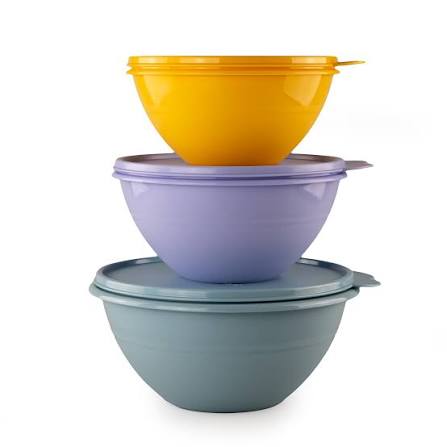
In 1946, Earl Tupper’s translucent plastic Wonder Bowl sold for 39 cents and got a write-up in House Beautiful calling it “fine art for 39 cents,” according to Smithsonian Magazine’s account of the company’s early years. It still barely sold. By 1954, the company built around that same bowl was doing $25 million a year — north of $230 million in today’s dollars — and the difference between those two facts wasn’t the product. It was who was selling it, and where.
A Bowl Too Strange for the Shelf
Tupper’s design was genuinely clever: a flexible, airtight polyethylene container sealed by a lid he’d patented, made from refined oil byproducts that gave the plastic its signature translucence. Industry critics praised it. Department store shoppers mostly ignored it. According to AIGA’s Eye on Design, plastic kitchenware in the late 1940s still read to most shoppers as an “alien substance,” something tied to industrial oil rather than the dinner table, and the seal itself required a “burping” motion to release trapped air — an unfamiliar gesture for women used to simply setting a lid on a glass jar. A genuinely useful product was failing for a distribution reason, not a design reason, and nobody at the company had quite diagnosed that yet.
The Saleswoman Who Diagnosed the Actual Problem
Brownie Wise had no engineering background and no formal role at Tupper’s company when she started selling the bowls. A recently divorced single mother in Florida, she had been supporting herself selling for Stanley Home Products before starting her own outfit, Patio Parties, and applying the same in-home demonstration model to Tupperware. The results were immediate in a way department store shelves never managed: by 1949, one of her saleswomen moved more than 56 Wonder Bowls in a single week, per Smithsonian’s reporting. Wise had effectively solved Tupper’s burping problem without touching the product at all — she just made sure someone demonstrated it in person, in a living room, to an audience already inclined to trust the person doing the demonstrating.
From Living Rooms to a Business Week Cover
Earl Tupper noticed. In 1951, he made Wise vice president of marketing — an unusually senior title for a woman in corporate America at the time — and pulled Tupperware out of department stores entirely, committing the company fully to the home party model Wise had proven out on her own. The bet paid off fast: by 1954, Wise’s network had grown to roughly 20,000 dealers, distributors, and managers nationwide, and Tupperware’s annual sales hit that $25 million mark, according to Smithsonian’s figures. That same year, Wise became the first woman to appear on the cover of Business Week, a milestone AIGA’s design history also credits to her.
Her operating philosophy was blunt and, as Smithsonian’s account documents it, effective: “You build the people and they’ll build the business.” It wasn’t a slogan dreamed up by a corporate marketing department — it was the actual mechanism. Every dealer recruited more dealers, every home party generated the next host’s party, and the whole structure ran on the same social trust that made a living-room demonstration work better than a department store display ever could.
The Model Outlived the Bowl
Tupperware’s story doesn’t stay simple — Wise was pushed out by Tupper in 1958 despite having built the sales engine that saved the company, a messier chapter than the “fine art for 39 cents” origin story usually gets credit for. But the core insight survived every leadership change that followed: a product nobody trusted enough to buy off a shelf became one people would buy a whole set of, in front of their neighbors, from someone they already knew. The home parties kept running for decades after Wise’s departure, spreading to new products, new decades, and eventually new countries, long after the specific woman who invented the format had been written out of the company’s own telling of its history.
That’s not really a story about plastic bowls. It’s a story about distribution beating invention, and about how the person who figures out where and how to sell something can end up mattering more than the person who invented it in the first place — a lesson that shows up again every time a product finds its real audience not on a shelf, but through someone willing to vouch for it in person.

Leave a Reply