

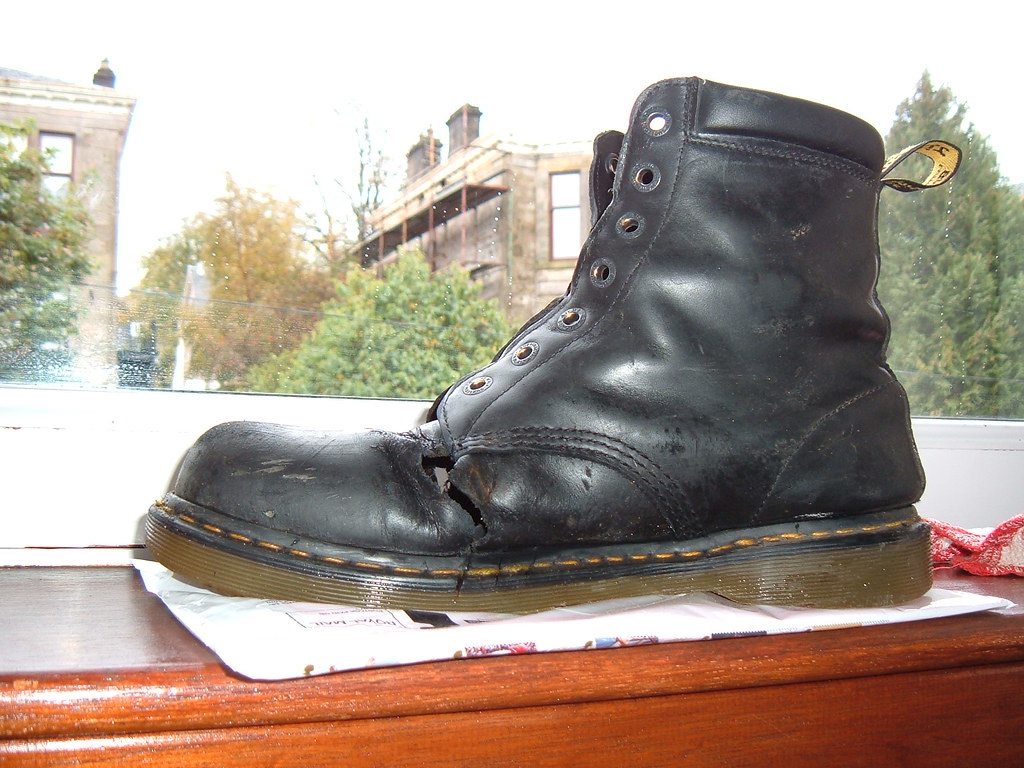
Two pounds. That is roughly what British postmen and factory workers paid for a pair of Dr. Martens 1460 boots when they went on sale on April 1, 1960, according to Dr. Martens’ own corporate history. Nobody involved in that launch was thinking about punk rock, runway shows, or teenagers customizing the leather with paint markers. They were thinking about sore feet on long shifts. Fifteen years and two countries later, that same boot would become one of the most recognizable objects in youth culture, and the entire chain of events traces back to a German soldier’s broken foot.
A War Injury Started It
In 1945, 25-year-old Klaus Maertens was recovering from a broken foot in post-war Munich when standard hard-leather military soles proved unbearable to walk in. He engineered an air-cushioned sole instead, then partnered with mechanical engineer Herbert Funck to refine it, according to Dr. Martens’ official history. The pair began formal production in 1947 using salvaged military supplies, and the design caught on fast enough among German consumers — especially older women who liked its comfort — that the operation expanded to a full Munich factory by 1952, per the company’s own account.
An English Bootmaker Found It in a Trade Magazine
The boot might have stayed a regional German product if the R. Griggs Group, a third-generation English footwear manufacturer based in Wollaston, Northamptonshire, hadn’t spotted an advertisement for it in a trade publication. Bill Griggs secured an exclusive license for the UK market in 1959 and immediately modified the design, adding a distinctive yellow welt stitch, a grooved sole edge, and a reworked undersole, according to Dr. Martens plc’s brand history. The finished product launched on April 1, 1960 — and took its name, 1460, directly from that date, as the brand’s own archive puts it. A lower-cut shoe version, the 1461, followed a year later in 1961 and remains part of the line today, per Dr. Martens plc’s own account of the launch.
Postmen First, Rock Stars Second
For most of the 1960s, the 1460 was exactly what it looked like: affordable, durable workwear aimed at postal carriers and factory floors, not a fashion statement. It sat in the same category as a good pair of work gloves — bought for the shift, not for a look — and its selling points were the air-cushioned sole’s comfort and a build sturdy enough to survive years of daily wear on hard floors and wet pavement. That started to shift when Pete Townshend of The Who became the first widely recognized musician to wear the boots publicly, turning a piece of utilitarian gear into a marker of working-class pride, according to Dr. Martens’ history page. From there, the audience kept widening in directions the Griggs family never planned for — multicultural skinhead communities adopted the boots next, using them as a badge of identity years before punk existed as a genre.
From Subculture Uniform to Runway Fixture
By the end of the 1970s, the same boot built for mail routes had become, in the company’s own words, “a symbol of self-expression at the very heart of British youth culture,” moving through punk, glam, and early goth scenes, per Dr. Martens plc. Women started customizing men’s-cut pairs with floral paint and studs, and American hardcore musicians carried the brand across the Atlantic, setting up its adoption by grunge and Britpop audiences through the 1990s. The company nearly collapsed in the early 2000s, but high-fashion designers helped pull it back from the brink, and hand-finished production resumed at the original Cobbs Lane factory in 2007, according to the official company history.
A Boot That Kept Getting Reassigned
What makes the 1460’s path unusual isn’t that it survived six decades — plenty of workwear does. It’s that every generation that picked it up rewrote what it meant, from postal-route practicality to skinhead signaling to punk defiance to grunge disaffection to a fashion house’s idea of edge, without the boot itself ever really changing. The object stayed the same eight-hole leather boot with a yellow stitch. The meaning was never the manufacturer’s to control.
That is arguably the real reason the 1460 outlasted nearly every other piece of 1960s workwear still sold today largely unchanged. A boot built for comfort on a factory floor doesn’t automatically end up on a punk stage or a runway; it takes a design plain enough to absorb whatever a subculture needs it to say. Dr. Martens didn’t design a symbol in 1960. It designed a boot sturdy enough to still be standing when the next generation decided to make it one.

Leave a Reply