

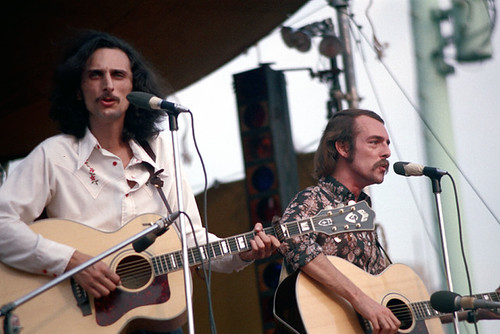
Elton John and Kiki Dee held the number one spot the exact week Boston’s self-titled debut album hit record store shelves, and the rest of that chart reads like a cross-section of everything AM and FM radio was juggling at once in the summer of 1976 — disco just breaking wide, soft rock still dominant, and funk pushing its way into the top ten.
What Was Actually Number One
Boston’s debut arrived in stores on August 25, 1976, according to its own Wikipedia release record, and the Billboard Hot 100 dated August 28, 1976 — the chart closest to that release date, pulled straight from Billboard’s own historical archive — shows exactly what listeners were hearing on the radio that same week. “Don’t Go Breaking My Heart,” the Elton John and Kiki Dee duet, sat at number one. Right behind it at number two was the Bee Gees’ “You Should Be Dancing,” the group’s first true disco crossover smash and a preview of the sound that would swallow pop radio whole within eighteen months.
A Chart in Transition
The rest of that same top ten, per Billboard’s archive, tells the story of a format in the middle of a genuine identity shift. Wings held number three with “Let ‘Em In,” a holdover from the softer end of the pop spectrum, while Lou Rawls sat at number four with “You’ll Never Find Another Love Like Mine.” KC and the Sunshine Band’s “(Shake, Shake, Shake) Shake Your Booty” held down number six, and Wild Cherry’s “Play That Funky Music” — a song that would eventually hit number one itself just a few weeks later — sat at number seven. Walter Murphy’s disco reworking of Beethoven’s Fifth Symphony, credited to Walter Murphy & The Big Apple Band, rounded out the top ten at number eight. Four different genres occupying the same ten-slot chart in the same week is not something Top 40 radio does casually; it’s what a format looks like right before it commits fully to one direction.

Photo: Unsplash
Who Actually Made Boston’s Album
Part of why Boston’s debut hit so differently than a typical rock record of the era comes down to who made it and how. The album was co-produced by Tom Scholz, the band’s guitarist and a former product engineer at Polaroid, working alongside John Boylan, according to Wikipedia’s account of the record. Scholz had built much of the album’s guitar and keyboard work in a home basement studio over several years before Epic Records ever signed the band, meaning the polished, layered sound that made Boston stand out against the looser album-rock records surrounding it on 1976 radio was largely the product of one meticulous engineer’s home setup rather than a big-budget studio session.
Boston Wasn’t on the Radio Yet — And Then It Was Everywhere
Here’s the twist: none of Boston’s music was actually charting the week their album dropped. The band’s breakout single, “More Than a Feeling,” wasn’t released until September 1976, a month after the album itself, per Wikipedia’s account of the rollout. But the album didn’t need the single to move. Boston’s Wikipedia entry notes the record broke out first in Cleveland and had been added to 392 radio stations within a single week of release — an extraordinary rate of adoption for a debut act with zero chart history. The album went gold, 500,000 units, in just three weeks, and hit platinum by November 11, 1976, less than three months after it hit shelves.
The Fastest-Selling Debut of Its Era
By the time “More Than a Feeling” caught on at both AM Top 40 and the newer FM album-rock stations, the album underneath it had already sold two million copies, a figure it reached by January 1977, according to Wikipedia’s sales chronology. It’s been described as the fastest-selling debut album by an American group up to that point, and it would go on to move roughly 17 million copies domestically by 2003 — a number that still makes it the second-best-selling debut album in U.S. history, trailing only Guns N’ Roses’ Appetite for Destruction.

Photo: Unsplash
So the actual radio landscape the week Boston’s album hit shelves had nothing to do with Boston at all — it was Elton John duets, early disco, and funk crossovers fighting for the same airtime. Boston’s arrival on that airwave a month later wasn’t a gradual climb up a chart. It was closer to a takeover, and the band did it with a debut album that outsold almost everything already sitting in that August 1976 top ten combined.

Leave a Reply