

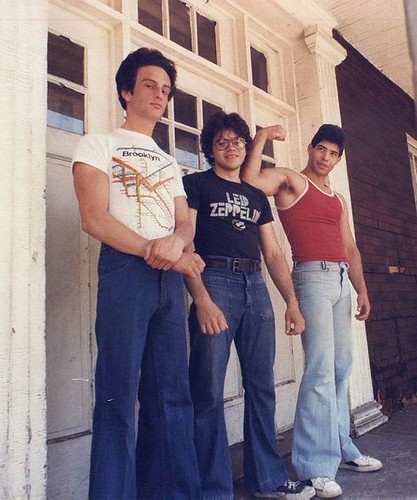
Sailors were rolling their pant legs above the knee to swab a deck a century and a half before anyone in a Woodstock crowd embroidered a peace sign onto a pair of flares. The wide-legged trouser that defines 1970s fashion in nearly every retrospective didn’t start on a runway or in a designer’s sketchbook. It started as regulation Navy issue, and the paper trail for that goes back further than most people assume.
A War of 1812 Wardrobe Choice
According to the Naval History and Heritage Command, the flared trouser shows up in Navy service records as early as 1813, when sailors serving under Commodore Stephen Decatur were described as wearing “blue trousers with bell bottoms.” The first formal regulation followed a few years later: in September 1817, Secretary of the Navy Benjamin Crowninshield prescribed a winter uniform of “blue jacket and trousers, red vest, yellow buttons and black hat,” officially writing the cut into naval dress for the first time.
The Flare Wasn’t for Looks
The wide leg openings solved a genuinely unglamorous problem. Per Crowninshield’s own regulations, cited by the Naval History and Heritage Command, sailors ordered to wash the decks “were to be barefooted and have their pants rolled up.” A trouser cut wide at the ankle rolls cleanly above the knee without binding, which made it the practical choice for a job that meant working barefoot in standing water every day. The U.S. Army’s own Culture.mil history of the garment adds that the cut had a second job too: a sailor who went overboard could slip the soaked trousers off over his boots in seconds, and in a pinch, the legs could be knotted and filled with air as a makeshift flotation aid. That’s two separate practical arguments for the same silhouette, from two different service branches’ own historical records, well over a century before it meant anything to a fashion magazine.

Photo: Unsplash
Thirteen Buttons, One Myth
Anyone who has ever heard that the trouser’s signature front flap carries thirteen buttons to honor the original thirteen colonies is repeating a story the Navy’s own historians have gone out of their way to correct. The Naval History and Heritage Command’s record states plainly that before 1894 the front, known as the broadfall, closed with only seven buttons. The jump to thirteen came later, when the broadfall itself was widened, and the extra buttons were added “to the symmetry of the design,” not as a patriotic tribute. It’s a small detail, but it’s the kind of thing that separates a documented uniform history from the version that gets repeated at trivia night.
From Deck Gear to Dance Floor
The Navy actually phased bell-bottoms out and then brought them back, which complicates the tidy “always Navy, then always disco” version of the story. Culture.mil notes that the trouser stayed almost exclusively military wear until the 1960s, when it broke into civilian closets fast and for reasons that had little to do with the runway. The counterculture and anti-war movements of the decade pushed young people toward cheap, secondhand clothing, and military surplus stores were stocked with exactly this pant. Wearers embroidered flowers and peace symbols onto the legs and turned a uniform piece into a statement against the establishment it came from — which is a genuinely strange twist for a garment invented so a sailor could mop a deck faster. By the time the look peaked in the mid-1970s, the connection to naval service had mostly been forgotten by the people wearing it.

Photo: Unsplash
Meanwhile the Navy kept fiddling with its own version. The Naval History and Heritage Command records that Admiral James L. Holloway III announced a return to bell-bottoms in 1977 after the cut had briefly been phased out of the uniform, with wear tests starting in 1978 using fabrics that hadn’t existed in the trouser’s earlier decades. So while bell bottoms were topping out as a civilian fashion statement, the actual Navy was mid-debate about whether to keep wearing them at all.
Why the Confusion Persists
Part of why the fashion-invention myth sticks is timing: the look’s civilian peak and its documented military record are separated by roughly a century and a half, long enough that the original context faded from public memory entirely. But the paper trail is unambiguous once you go looking for it — an 1813 sailor’s description, an 1817 regulation, a button count that changed for tailoring reasons in 1894, and a 1960s surplus-store afterlife that turned a working uniform into a countercultural uniform of a different kind. The flare was never designed to make a statement. It was designed to come off fast and dry faster, and it took a hundred and fifty years and an entirely different generation to turn that into a look.

Leave a Reply