

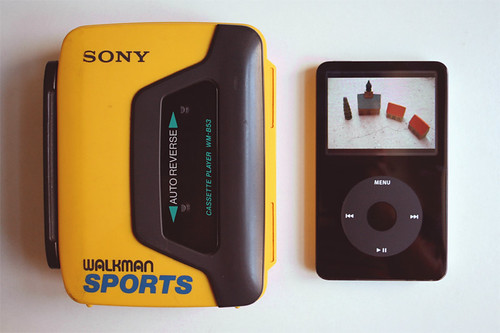
Sony’s first Walkman sold just 3,000 units in its debut month, a fraction of the 30,000 units the company had already manufactured. Six weeks later, every one of them was gone. That whiplash — from a product nobody wanted to one nobody could find on shelves — happened because Sony sent employees onto the streets of Tokyo and simply let strangers try it. What launched on July 1, 1979 as a modest cassette player became the template every iPod, MP3 player, and pair of AirPods since has quietly followed.

A Recorder With the Recording Function Removed
According to History.com’s dated account of the launch, the device — officially the TPS-L2 — went on sale in Japan on July 1, 1979, priced around 30,000 yen, roughly $150 at the time. The idea began with Sony co-founder Masaru Ibuka, who, according to the collection record held by London’s Victoria and Albert Museum, found Sony’s existing TC-D5 field recorder too bulky to travel with and wanted something smaller for personal use. Sony’s engineers adapted the Pressman TCM-5000, a compact recorder built for journalists, by adding stereo sound and stripping out the recording function entirely — a device built to do only one thing well. Internally, the pitch wasn’t universally popular. History.com quotes Ibuka’s response to skeptical colleagues, a line the site calls “one of the great understatements in business history”: “Don’t you think a stereo cassette player that you can listen to while walking around is a good idea?”
Thirty Thousand Units, Then a Street Campaign
Development took only about four months, timed so the device could launch before Japan’s summer vacation season, per History.com’s account. Sony built an initial run of 30,000 units, but the first month sold only about 3,000 — a slow enough start that the company changed tactics, sending representatives out to hand the device directly to pedestrians in Tokyo so they could hear it for themselves. The gamble worked: by the end of August 1979, the entire initial production run had sold out. The device didn’t even launch under one name globally — the V&A’s record notes it was sold as “Soundabout” in the United States, “Stowaway” in the United Kingdom, and “Freestyle” in Sweden before Sony settled on “Walkman” everywhere. Early units also shipped with two headphone jacks and a “hotline” button that let two people share a single player and talk to each other over an embedded microphone, a feature the V&A’s design notes describe as an attempt to keep the experience social rather than solitary. It’s a small detail that says a lot about how uncertain even Sony was about what it had built — the company assumed people would want to share the thing, when the entire appeal, it turned out, was that they didn’t have to.
From a Skeptical Pitch to 200 Million Units
The social framing didn’t stick, but the habit of private, portable listening did. The Smithsonian’s National Museum of American History holds an original TPS-L2 in its permanent collection, and London’s Design Museum lists the Walkman among its core objects of 20th-century design — both treating it as a genuine turning point in how people experienced recorded music, no longer tied to a living room or a car dashboard. That shift proved durable: when Sony finally ended domestic production of the cassette Walkman on October 25, 2010, NPR reported the company had sold more than 200 million cassette Walkman units since that first, uncertain launch three decades earlier. The report noted that an entire generation had, by then, grown attached to headphones and homemade mix tapes as a basic part of daily life — a habit that didn’t disappear when the cassette did, it just migrated onto a playlist.

Still the Same Idea, Just Smaller
Nobody at Sony in 1979 was trying to invent the iPod. They were trying to solve one executive’s complaint about a heavy field recorder, on a four-month deadline, with an idea a good number of their own colleagues doubted. What they built instead was the first version of an assumption every headphone wearer now takes for granted without a second thought — that music belongs to the listener, not the room, and that carrying it around should be as easy as carrying anything else in your pocket.

Leave a Reply