

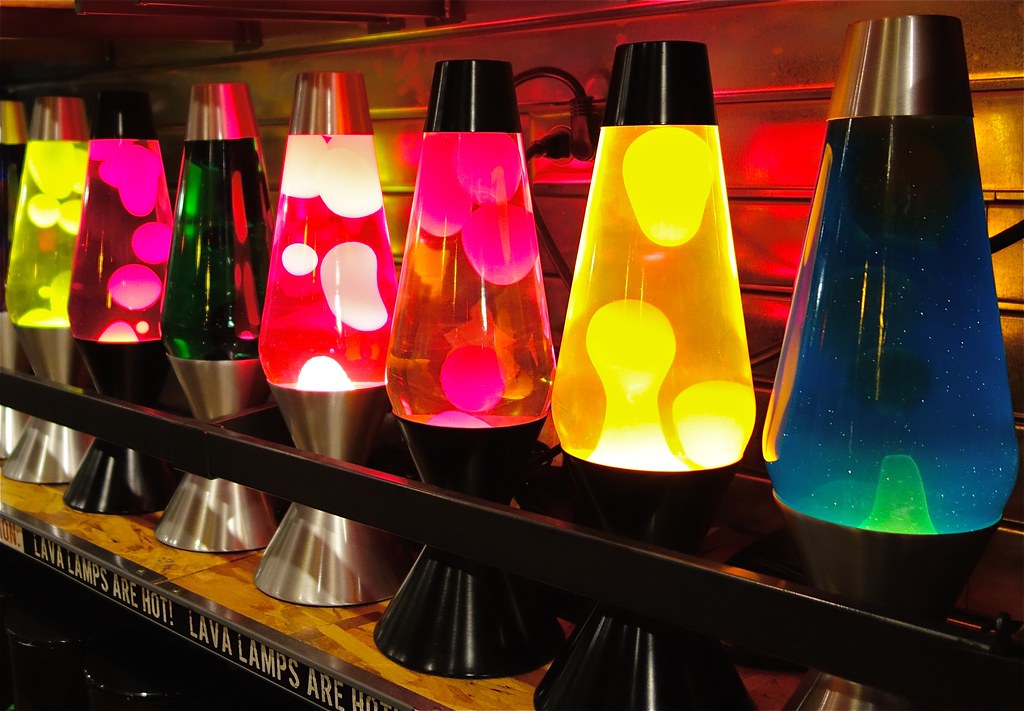
The man who invented the lava lamp ran a naturist resort in the English countryside, produced underwater nudist films under a fake name to dodge British censors, and originally marketed his glowing, oozing creation as a serious executive desk accessory — mounted on a walnut base, aimed at office managers, not hippies. Edward Craven Walker had no interest in starting a counterculture revolution. He got one anyway.

A Pub, an Egg Timer, and a Decade of Tinkering
The idea started in an English pub sometime around 1948, when Walker, then a Royal Air Force veteran turned entrepreneur, spotted a homemade contraption behind the bar: a cocktail shaker rigged as an egg timer, filled with oil that bubbled and rose as the egg boiled. According to HISTORY, Walker was so taken with the effect that he bought the patent from the original inventor’s widow and spent roughly a decade refining it — swapping in an Orange Squash bottle for the vessel and a simple light bulb as the heat source underneath.
What he landed on was a genuinely clever piece of chemistry. Smithsonian Magazine explains that the lamp works by combining two liquids that don’t mix — a water-based solution and a wax-based one, with carbon tetrachloride added to the wax to make it just dense enough to sink when cool. Heat from the bulb below warms the wax until it expands, becomes less dense than the water around it, and drifts upward in slow, blobby plumes — then cools near the top, sinks back down, and repeats the cycle indefinitely. Walker founded a company called Crestworth and unveiled the finished product — the Astro Lamp — at a British trade show in 1963.
From Naturist Camps to Executive Desks
Walker’s personal life ran in parallel to his invention, and the two were more connected than his conservative marketing suggested. Around 1948 — the same period he encountered that fateful egg timer — Walker visited a French naturist community on the Île de Levant and became a lifelong devotee of nudism. He went on to produce a string of underwater nudist films under the pseudonym “Michael Keatering,” carefully framing them as documentary footage of nudist camps to slip past British censors, and used the proceeds to found the Bournemouth and District Outdoor Club, a naturist resort in Dorset that he ran for decades.
None of that made it into the Astro Lamp’s early advertising. Smithsonian notes Walker pitched an “executive” version of the lamp mounted on a walnut base, positioning it in trade publications as a sophisticated desk accessory for professional men — a pitch almost comically at odds with what the product actually became.

Adopted by a Movement Walker Never Courted
The counterculture found the Astro Lamp anyway. In 1965, two American entrepreneurs bought the worldwide marketing rights and rebranded it the “Lava Lite” lamp for the U.S. market, and it landed squarely inside the psychedelic explosion already reshaping music, fashion and interior design. Counterculture MC and Woodstock fixture Wavy Gravy summed up its appeal bluntly, saying the lamp worked because “it causes synapses in your brain to loosen up.” By the mid-1970s, roughly seven million units were selling annually worldwide, and the lamp had become inseparable from the era’s visual language — a fixture of dorm rooms, dens, and anywhere someone wanted their walls to look like they were breathing.
A Near-Death and a French Film
The lamp’s fortunes didn’t last through the following decade. As disco gave way to minimalism and beige interiors took over the 1980s, sales collapsed to around 1,000 units a year by decade’s end. The brand survived largely because Walker, by then aging, partnered in 1989 with entrepreneur Cressida Granger, who bought into the company and eventually took it over outright. In 1992 the business was renamed Mathmos — a nod to the molten planetary substance from the 1968 cult film Barbarella — and by 1999, annual sales had climbed back above 800,000 units. Walker died in 2000, just as the lamp he’d spent a decade perfecting was crawling its way back into fashion. Mathmos still manufactures lamps in Poole, Dorset, using a version of his original oil-wax-water formula, and Lava Lite continues supplying millions more each year to retailers across the U.S.
The Joke That Outlived the Punchline
There’s a real irony sitting inside every lava lamp still glowing on a shelf somewhere: the man who built it wanted it taken seriously, marketed as a status object for buttoned-up professionals, and instead watched it become shorthand for everything loose, trippy, and anti-establishment about an era he mostly observed from his own private nudist resort. Walker never got the executive desk accessory he pitched — he got something far stranger and, as it turned out, far more durable.

Leave a Reply