

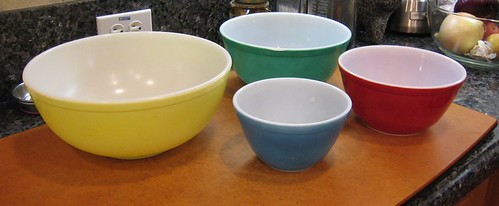
A blue Butterprint mixing bowl recently sold on eBay for $2,100. A single Lucky in Love casserole dish, a pattern Corning only tested in 1959 and barely released, fetched more than $4,000 in a widely cited 2015 sale. If a stack of mismatched glass bowls has been sitting in your grandmother’s cabinet since the Nixon administration, it might be worth pulling them out before the next donation-bin run — because collectors are currently paying real money for specific, discontinued Pyrex colorways, and most sellers have no idea what they’re holding.
The Patterns Actually Worth Money
Not all vintage Pyrex is valuable — most of it is worth exactly what a thrift store charges. But a handful of limited-run patterns from the 1950s through the 1970s have turned into genuine collector targets, according to vintage dealers interviewed by Fox News. Blue Butterprint, Pink Daisy, Turquoise Snowflake and the ultra-rare Lucky in Love pattern top most want-lists. Gooseberry, produced between 1957 and 1966, regularly sells as a full nesting set for $699, while a Gooseberry set that still has its original box brought $550 through the Etsy shop Rosie’s Vintage, according to owner Thea Morales. A Pink Pyrex set has listed for $2,189.95 and an Orange Butterprint set for $2,169.95, both on Etsy, per the same Fox News reporting.
There’s also a lesser-known category collectors specifically hunt for: the 1965-to-1967 rainbow-striped nesting bowls, sold in pink, tan and blue under model numbers 401, 402 and 403. Vintage lifestyle writer Melanie Dawn reported for Hunker that “it’s not uncommon to see a three-piece bowl set in excellent condition going for as much as $750 online” — a striking number for dishware that was mass-produced as everyday kitchenware and often mistaken for something disposable.

Why These Specific Colors Vanished
Corning Glass Works launched Pyrex as a brand in 1915, building a business on the idea that affordable, attractive glass housewares belonged in every American kitchen, according to the Corning Museum of Glass, which has run a dedicated exhibition on the brand’s century-long run. Decades later, the specific colorways that collectors chase today are valuable largely because of how briefly they existed: patterns like Lucky in Love were test releases that barely reached stores, while others were regional exclusives or limited production runs that Corning discontinued within a few years. That built-in scarcity, combined with decades of dishwashers, chips and broken lids thinning out the surviving supply, is what turns an ordinary mixing bowl into a four-figure listing.
What Actually Determines the Price
Condition does most of the heavy lifting. Tim Dowdle, store manager at Cedar Chest Antique Mall in McGregor, Texas, told Fox News that dishwashers are the enemy of vintage Pyrex — the harsh detergent dulls the glaze and strips the shine that collectors pay a premium for. Original glass lids matter just as much; a bowl or casserole missing its matching lid can lose a significant chunk of its resale value, since lids were often broken or misplaced long before the base ever hit a thrift shelf. Rarity compounds both factors: a piece produced in an unusual size, in a short-lived colorway, or in an unproduced test run will always outprice a common Butterprint bowl in the same condition.
Interest isn’t just nostalgia, either. Vintage dealer Louis Prizzi, who sells through Instagram, and Long Island collector Alyssa Durante both pointed to shows like “Mad Men” and “The Marvelous Mrs. Maisel” for reviving visual interest in mid-century kitchens, per Fox News’s reporting, while sustainability concerns are pulling younger buyers toward durable secondhand glassware instead of newer, flimsier bakeware.
Where the Money Actually Changes Hands
The bulk of high-value sales are happening on eBay and Etsy rather than in physical stores, where sellers like Yvette Egan of the Madison, Wisconsin-based shop ParkwoodTreasures and Kathy Studensky of Thistle Attic have built followings around spotting undervalued pieces. But bargains still surface in antique malls and estate sales — Cedar Chest’s Paulette Kilpatrick noted that a black casserole with a white interior recently sold for just $100, well under what a rarer piece in the same condition might command. The lesson dealers repeat most often: check the bottom of every glass bowl for a pattern name and production stamp before assuming it’s just an old dish.

The real value in a Pyrex cabinet isn’t the whole set — it’s whichever single bowl nobody in the house has ever run through the dishwasher.

Leave a Reply