

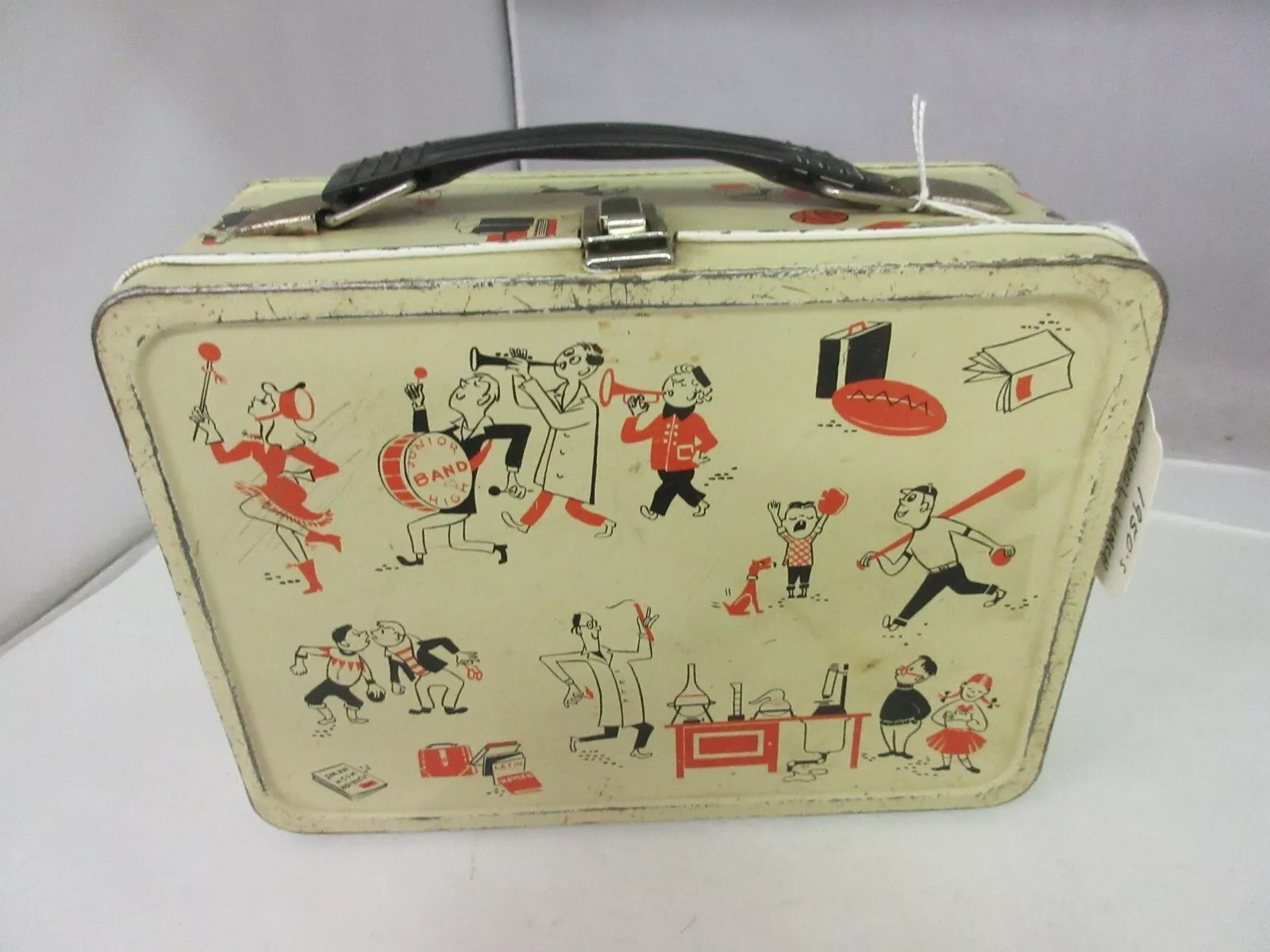
In 1985, American manufacturers quietly stopped stamping out steel lunchboxes covered in cartoon characters and TV heroes, not because kids had lost interest, but because enough parents worried the boxes made decent playground weapons. That reasoning is recorded in the Smithsonian’s own catalog notes for a lunchbox in its collection, which state plainly that metal boxes stopped being manufactured in 1985 once concerned mothers raised the alarm. It was a quiet ending for a format that had ruled school hallways for half a century, ever since a Wisconsin tin company put Mickey Mouse’s face on a steel lunch pail in 1935. Within a few years of that 1985 halt, the metal lunchbox aisle was simply gone.
From Tin Toy to Status Symbol
The lunchbox most Americans picture traces back to 1935, when Geuder, Paeschke & Frey put Mickey Mouse on a steel box and produced what is usually called the first licensed character lunchbox. It stayed a modest seller until after World War II, when a growing middle class had money to spend on “all kinds of things, including lunchboxes,” as CNN reported in a history of the format. The real turning point came around 1950, with a Hopalong Cassidy box usually cited as the lunchbox industry’s first true television tie-in. From there, the metal lunchbox stopped being just packaging and started being a signal. Peter Liebhold, a curator at the Smithsonian’s National Museum of American History, told CNN that in the postwar decades, “identity in the postwar period was seen through consumed items so individuals were picky about what their lunchbox said about them.” A steel box with the right cartoon on it was a kid’s first real brand loyalty, decades before sneakers took over that job.

Why the Steel Stopped
Two forces hit the metal lunchbox at once. The Smithsonian’s collection record is blunt about the first: enough mothers decided that a hard steel box with sharp corners and a metal clasp could double as a weapon on the playground, and manufacturers halted production in 1985. The second force was plainer economics. Smithsonian Magazine, reporting on the country’s largest private lunchbox collection, notes that the format’s “heyday lasted until the mid-1980s, when manufacturers turned from metal to less expensive materials like vinyl” — a straightforward cost decision that happened to land at the same moment as the safety complaints. Vinyl gave way to hard plastic within a few years, and a design that had survived the Depression, a world war, and fifty years of playground abuse quietly disappeared from store shelves.
The Smithsonian’s own collection shows exactly what replaced it. A 1993 Aladdin Industries lunchbox in the museum’s holdings, decorated with art from Disney’s “Aladdin,” is hard plastic rather than steel, built with a plastic snap latch and a hinged plastic carrying handle instead of the old metal clasp and handle. Its movie artwork was, in the museum’s own description, “papered on” rather than printed directly onto the material the way character art used to be lithographed straight onto tin. It sounds like a minor manufacturing detail, but it captures the entire shift in a single object: the picture that once was the box became something glued on top of a cheaper one.
Where They All Ended Up
The metal lunchbox didn’t really vanish. It migrated, from cafeteria tables into display cases. The Smithsonian’s own Taking America to Lunch exhibition features illustrated metal lunchboxes spanning the 1890s through the 1980s, presented as a running barometer of what was popular in American culture at any given moment. CNN reported that an earlier run of that same exhibit included 75 illustrated metal lunchboxes telling that pop-culture story. The bigger stash sits in Columbus, Georgia, where the world’s largest private lunchbox collection has grown to more than 3,000 boxes and 1,000 matching thermoses, according to Smithsonian Magazine. Rare pieces now change hands for real money: a 1957 “Toppie the Elephant” lunchbox sold for more than $3,500 at auction in 2021, per the same report. Not bad for an object that public schools were once actively trying to get rid of. The same collection has kept growing well past its 1985 founding, one box and thermos at a time, which is its own small proof that the format never really lost its audience, only its manufacturers.
The metal lunchbox’s second life proves something that keeps happening to mid-century mass-market objects: the exact qualities that got a product pulled from shelves, solid, distinctive, built to outlast the kid who carried it, are precisely what make people hunt it down decades later.

Leave a Reply