

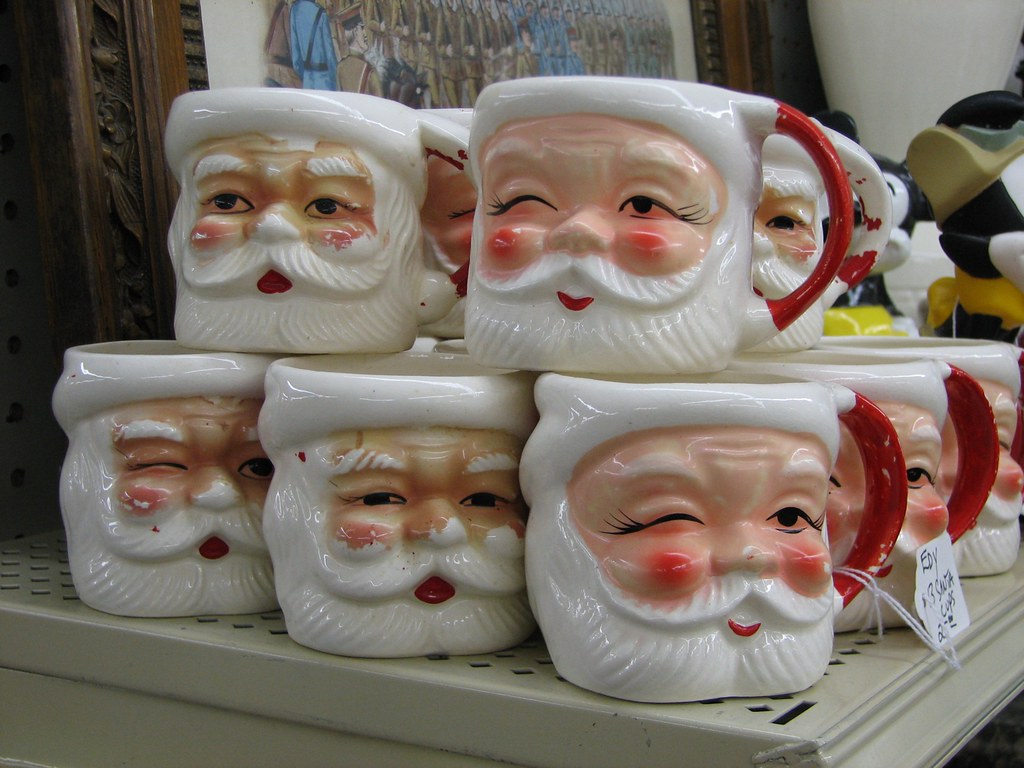
Vintage Santa mugs are having a serious moment, and collectors are shelling out real cash for the right jolly face. Just like old-school Christmas cards and childhood toys, these cheery cups prove that holiday nostalgia can turn into a surprisingly valuable little side hustle. Here are eight types of Santa mugs that tend to catch collectors’ eyes and can command big money when condition, rarity, and charm all line up.
1. Mid‑Century Japan Ceramic Santa Mugs
Mid‑century Japan ceramic Santa mugs are often the first stop for collectors chasing big-ticket holiday nostalgia. These mugs usually feature bright red suits, rosy cheeks, and that slightly kitschy expression that screams 1950s and 1960s. They tap into the same appeal as older holiday paper goods, where a simple seasonal design can suddenly be worth serious money once it crosses into “antique” territory. Just as certain antique Christmas cards gain value from age and charm, these Japanese imports ride a wave of mid‑century holiday design that collectors love.
For buyers, the stakes are all about scarcity and condition. Mugs with intact cold paint, original decals, and no crazing or chips can sell for far more than the flea‑market average. Collectors also pay attention to tiny details like the shape of Santa’s beard or the style of the handle, which can hint at specific factories or production runs. As more people revisit the decorations they remember from grandparents’ homes, prices for standout examples keep climbing, especially for sets of four or six.
2. Holt‑Howard Winking Santa Mugs
Holt‑Howard winking Santa mugs are the poster child for high‑end Christmas kitsch. These mugs, with their exaggerated lashes and playful wink, sit in the same nostalgia lane as classic toys that now sell for hundreds of dollars, much like the way certain vintage childhood toys have exploded in value. Collectors chase specific Holt‑Howard markings and original box sets, because those details separate a casual thrift‑store find from a serious collectible that can command premium prices online or at specialty shows.
The market impact is clear: when one brand’s design becomes instantly recognizable, it turns into a benchmark for the whole category. Holt‑Howard mugs often set the ceiling for what people are willing to pay for Santa ceramics of similar age. That ripple effect pulls up prices on lesser‑known makers that mimic the same winking expression or stylized features. For sellers, spotting that tiny Holt‑Howard stamp can mean the difference between pricing a mug at a few dollars or listing it confidently in the triple‑digit range.
3. Napco Santa Head Punch Bowl Sets
Napco Santa head punch bowl sets take the humble Santa mug and scale it up into a full‑blown party centerpiece. These sets usually include a large Santa head bowl surrounded by matching mini mugs, turning a simple drink service into a collectible display. Because they were more expensive and fragile, far fewer complete sets survived decades of holiday use and storage. That scarcity, combined with the visual impact of a full ring of Santa faces, makes intact sets especially attractive to serious collectors.
From a value standpoint, the key is completeness. A punch bowl without its original mugs, or mugs missing the bowl, will still sell, but the top prices go to sets that have every piece and minimal wear. Collectors also look for original packaging or paperwork, which can push values even higher. As more people style vintage‑themed holiday bars and buffets, these Napco sets function as both decor and investment, driving demand each December.
4. Lefton “Santa and Mrs. Claus” Mug Pairs
Lefton “Santa and Mrs. Claus” mug pairs bring a slightly softer, storybook look to the Santa mug world, and that couple dynamic is exactly what makes them collectible. Instead of a single jolly face, buyers get a matched set that tells a little holiday story on the shelf. Because pairs are easier to break up over time, finding both characters in equally good condition can be tricky, which naturally pushes up prices for intact duos.
Collectors pay close attention to Lefton’s distinctive marks and the quality of the hand‑painted details. Fading on Mrs. Claus’s glasses or chips on Santa’s hat can knock values down, while crisp paint and clean interiors keep them in the “display‑ready” category. For decorators, these pairs anchor a mantel or cocoa station, so demand spikes around the holidays. That seasonal rush often reveals how much people are willing to pay to complete a set they remember from childhood.
5. Occupied Japan Santa Mugs
Occupied Japan Santa mugs sit at the intersection of holiday cheer and postwar history, which gives them a different kind of appeal. Pieces marked “Occupied Japan” were produced in a narrow window, so collectors know they are dealing with a specific era and geopolitical backdrop. That time‑stamped origin makes these mugs feel more like historical artifacts than generic decor, and buyers who collect Occupied Japan ceramics in general often treat Santa mugs as standout crossover pieces.
Because the production period was limited, the supply of authentic Occupied Japan Santa mugs is naturally capped. Condition still matters, but even lightly worn examples can attract attention simply because they are harder to find. For collectors who track broader trends, the rising interest in mid‑century and postwar design suggests that these mugs may keep gaining traction, especially when paired with other Occupied Japan holiday figurines or tableware in a cohesive display.
6. Plastic Santa Mugs from 1960s Party Sets
Plastic Santa mugs from 1960s party sets prove that value is not limited to fragile ceramics. These lightweight cups were often sold in big packs for kids’ parties, which means they were used hard, tossed around, and rarely stored with care. Surviving sets with bright graphics and no cracks are surprisingly tough to find, and that scarcity has started to catch the eye of collectors who specialize in retro plastics and mid‑century entertaining.
The stakes here are more about design than materials. Bold, cartoonish faces, unusual handle shapes, or original packaging can all bump up interest. Because these mugs tap into the same childhood‑memory lane as vintage toys and lunchboxes, they appeal to buyers who want a less breakable way to decorate for the holidays. As more collectors branch out from ceramics, complete plastic sets can command higher prices than their humble origins would suggest.
7. Department Store Promotional Santa Mugs
Department store promotional Santa mugs tie holiday nostalgia to specific retail memories, which gives them a built‑in fan base. These mugs were often handed out with cocoa, sold as limited‑time offers, or bundled with seasonal gift sets, so they carry logos or subtle branding from long‑gone stores. For collectors who grew up visiting those holiday windows and toy departments, owning the matching Santa mug feels like holding a tiny piece of retail history.
Value climbs when a mug can be clearly linked to a beloved store or a short‑lived promotion. Logos that are no longer in use, or stores that have since closed, tend to spark bidding wars among regional collectors. Because these pieces also document how companies marketed Christmas over the decades, they appeal to advertising and design buffs as well. That crossover interest keeps prices healthy, especially for mugs that still have their original tags or gift boxes.
8. Hand‑Painted Studio Santa Mugs from the 1970s
Hand‑painted studio Santa mugs from the 1970s bring a more personal, crafty vibe to the collector scene. Many were made in ceramics studios or hobby shops, so each one is slightly different, with unique brushstrokes, color choices, and facial expressions. That one‑of‑a‑kind quality sets them apart from mass‑produced lines and appeals to buyers who want something no one else has on their cocoa shelf.
Prices tend to spike for mugs with especially charming or unusual designs, like stylized folk‑art faces or unexpected color palettes. Signatures on the base, or markings from well‑known regional studios, can also boost interest. For collectors tracking broader trends, these mugs mirror the renewed love for handmade and small‑batch goods, turning what started as casual craft projects into sought‑after vintage pieces that round out a serious Santa mug collection.
More from Vinyl and Velvet:

Leave a Reply