

You step into a moment when a tired performer walked into a prison and changed his career overnight. Johnny Cash recorded At Folsom Prison on January 13, 1968, and the raw live album revived his public image and forced country music’s gatekeepers to reckon with grittier, more socially aware material.
The record’s success proved that authentic, unapologetic storytelling—performed in front of incarcerated listeners—could sell records and shift Nashville’s priorities.
This post will unpack why Cash chose Folsom, how the January 13 shows unfolded, the album’s immediate boost to his career, and the longer cultural ripple that made At Folsom Prison a turning point for American music.
The Story Behind At Folsom Prison
Johnny Cash wanted a raw, real performance that connected with people who lived on society’s margins. He saw the prison shows as a chance to revive his stalled career, test new material in front of an audience that knew the songs, and push country music toward grittier, more honest themes.
Why Johnny Cash Chose Folsom State Prison
Cash had long linked his identity to prison themes. He first wrote “Folsom Prison Blues” after seeing the film Inside the Walls of Folsom Prison while stationed in Germany, and the song became one of his signature numbers that resonated with incarcerated listeners. Over the years inmates sent him letters praising that song, which convinced him that prison audiences understood his voice.
By the late 1960s his career and personal life were in turmoil. Columbia Records and producer Bob Johnston agreed to a prison recording as a bold move to re-energize him. Folsom State Prison answered first when the team contacted several facilities, and its large population and proximity to Los Angeles made it practical for a live album experiment.
Inspiration from Inside the Walls of Folsom Prison
Cash treated the inmates as an audience with a special claim on his songs. He believed their responses would make the record authentic, not theatrical. The lyrics of “Folsom Prison Blues” and other tracks hit differently when sung to people who had lived parts of those stories.
Reverend Floyd Gressett and prison officials helped smooth logistics and permitted two shows on January 13, 1968. The inmates’ reactions—laughs, quiet moments, and bursts of applause—added texture to the recordings. That texture helped shift public perception of Cash from a fading star to a voice for the marginalized and laid groundwork for his advocacy on prison reform.
Planning the Concert and Live Recording
Cash, Bob Johnston, and Columbia Records planned two consecutive performances to ensure usable takes. They arranged for a touring backup group, the Tennessee Three, and invited Carl Perkins and the Statler Brothers to open, creating a compact, professional lineup that could handle the acoustics and security restrictions.
Technical planning focused on capturing a live feel while avoiding interruptions. Engineers brought portable recording gear and set up microphones to pick up both performers and audience sound. They coordinated with prison staff on seating, security, and timing, and approved a short setlist heavy on stories about confinement and redemption to suit the environment and make the final album cohesive.
The Legendary January 13, 1968 Performance
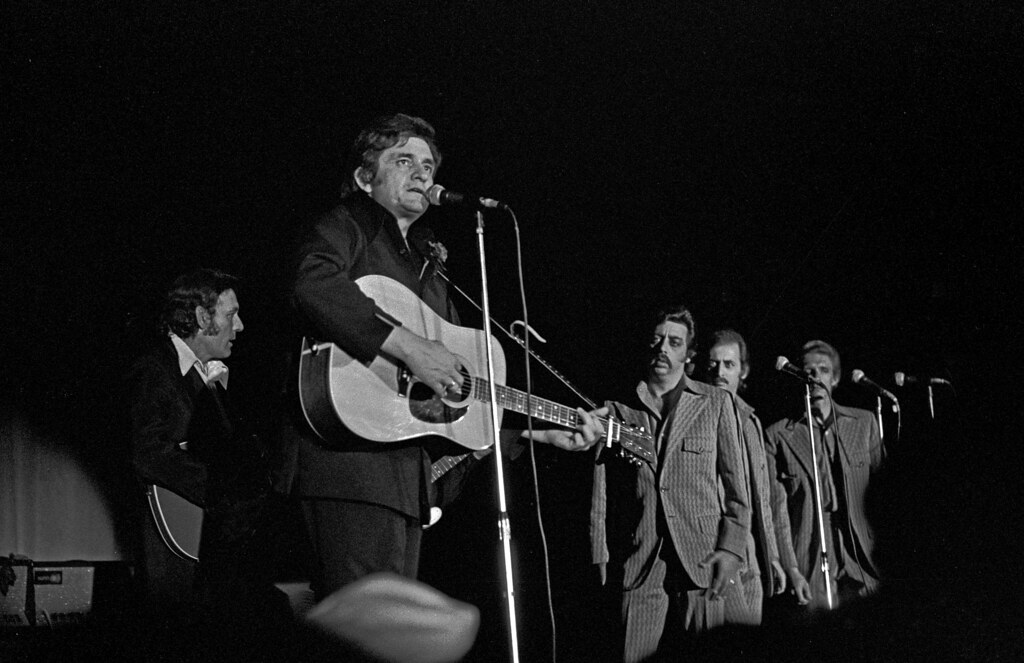
Johnny Cash entered Folsom State Prison that morning with a worn guitar, a small band, and a clear purpose: record live, connect with inmates, and make music that felt real. The concert produced the raw takes that became At Folsom Prison and reshaped Cash’s public image.
The Setlist and Notable Songs
Cash opened with high-energy numbers and steady storytelling songs that framed prison life. He performed “Folsom Prison Blues,” which set the concert’s tone, and included crowd favorites like “I Walk the Line” and “Jackson.” He also sang gritty tracks such as “Cocaine Blues” and “25 Minutes to Go,” which highlighted violence, humor, and mortality in front of an inmate audience.
The show balanced originals and covers. “Give My Love to Rose” and “I Still Miss Someone” offered quieter, emotional moments. Glen Sherley’s “Greystone Chapel” — written by an inmate — carried extra weight; Cash later helped Sherley record and pursue publishing. “Long Black Veil” and “Dark as a Dungeon” broadened the set’s narrative range and kept the room engaged.
The Band and Special Guests
Cash fronted the Tennessee Three: Marshall Grant on bass and the rhythm-playing Luther Perkins on guitar, giving the performance its trademark boom-chicka-boom drive. Carl Perkins added lead guitar flair on several numbers, sharpening the rockabilly edge. June Carter joined for duets and stage banter, adding warmth and humor that broke tension in the room.
The Statler Brothers provided vocal harmony on a few tracks, enriching gospel-tinged moments and call-and-response sections. Producer Bob Johnston and sound engineer Jim Marshall worked to capture the live immediacy; several songs came from two shows recorded that day. The presence of Cash’s core group and high-profile guests created a compact, well-oiled sound that translated directly to record.
Atmosphere and Audience Reaction
The prison audience reacted loudly, with cheers, laughter, and shouted requests that Cash acknowledged between songs. Inmates’ responses — applause after “Folsom Prison Blues” and nervous laughter during “25 Minutes to Go” — became part of the recording’s texture. The raw crowd noise and off-mic interactions made the album feel immediate and authentic.
Security constraints and the setting shaped the mood: guards remained present, and the stage area was modest. Yet the performance felt intimate; Cash addressed prisoners directly, wearing his “Man in Black” persona but showing empathy about incarceration and reform. The concert’s atmosphere—tense, candid, and occasionally tender—helped the record resonate beyond country audiences.
Impact on Johnny Cash and Country Music
The Folsom recording re-centered Johnny Cash’s public image, revived sales, and pushed country music institutions to take note of grittier themes and live performance energy. It also highlighted Cash’s role as an advocate for prisoners and showed Columbia Records a new commercial path beyond the polished Nashville sound.
Reviving Cash’s Career as the Man in Black
Cash’s career had stalled by the mid-1960s amid personal troubles and slipping record sales. The live set captured his dark stage persona — the “Man in Black” — and reintroduced him to a wide audience as a living, breathing performer rather than a studio act.
Columbia Records released the album in May 1968 and it quickly outsold his recent studio records. Radio play and TV appearances followed, and the record’s rawness made listeners and critics treat Cash as an urgent, authentic voice again. The performance also gave Cash leverage to pursue socially conscious projects and reinforced his image as an outsider who spoke for the downtrodden.
Changing Perceptions in Nashville
Folsom challenged Nashville’s prevailing production norms, which favored smooth arrangements and crossover polish. The record proved that a spare band, live ambience, and songs about prisoners and hardship could sell in large numbers.
Producers and musicians in Nashville took notice; some began to tolerate rougher storytelling and live-feel recordings. Labels like Columbia started to value authenticity alongside radio-friendly polish. While Sun Records remained associated with early rockabilly roots, Cash’s renewed success at Folsom pushed the industry to accept that country could embrace grit without losing mainstream viability.
Chart Success and Critical Reception
The album climbed the Billboard country charts and produced renewed interest in Cash’s back catalog. Critics praised the immediacy of the recording and its emotional clarity, often noting how the prison crowd contributed to the album’s power.
Reviews highlighted specific tracks — including the reinvigorated “Folsom Prison Blues” — as exemplars of Cash’s renewed artistry. Sales figures put the record among his most commercially significant releases of the era, and award nominations and retrospective acclaim cemented its place in music history.
Effects on the Legacy of Country Music
At Folsom Prison widened country music’s thematic boundaries by demonstrating an audience for songs about incarceration, redemption, and social marginalization. The album influenced artists who sought to combine storytelling with raw performance energy.
The recording also shaped how future live albums in country and popular music were conceived and marketed. It helped normalize taking country out of the studio and into unconventional venues, and it linked Cash’s name indelibly to a tradition of socially engaged country music that traced back to Sun Records’ early influence and forward into broader music history.
The Cultural Legacy of At Folsom Prison
The album reshaped how audiences and the industry saw incarcerated people, live recordings, and Johnny Cash’s role in American music. It pushed conversations about prison conditions and changed expectations for authenticity in country and popular music.
Prison Reform and Social Awareness
Cash’s January 13, 1968 performance at Folsom State Prison put prisoners’ voices into mainstream culture. The songs and Cash’s onstage remarks highlighted harsh daily realities—routine violence, lost families, and the cyclical nature of incarceration—forcing listeners to consider the human side of punishment.
Public attention from the record and subsequent media moved prison conditions into national conversation. Cash later visited San Quentin and advocated for better treatment of inmates, lending celebrity weight to reform efforts and helping legitimize calls for rehabilitation over purely punitive policies.
The album’s liner notes and Cash’s interviews framed prisoners as citizens deserving dignity. That framing influenced journalists, politicians, and other artists to treat incarceration as a social issue rather than only a criminal one.
Influence on Future Live Albums
At Folsom Prison set a template for raw, location-specific live recordings. Producers and artists began to see prisons, clubs, and unconventional venues as places that could give authenticity and narrative weight to a record.
Recordings like Cash’s San Quentin album followed directly, using audience noise, inmate responses, and unvarnished performances to create emotional immediacy. Live albums in rock, folk, and country increasingly aimed to capture atmosphere instead of polishing every vocal and instrument track.
The industry also adjusted marketing: labels promoted the backstory and venue as selling points. That shift helped live albums become commercially viable artistic statements rather than mere stopgaps between studio releases.
Continued Relevance and Recognition
Decades later, At Folsom Prison remains a touchstone in music history for its cultural impact and commercial success. It revived Johnny Cash’s career, broadened country music’s audience, and secured a place in archival collections and retrospective lists.
Institutions such as the Library of Congress and music historians cite the album when tracing country music’s expansion into social commentary. Modern artists still reference the Folsom performance when discussing authenticity, protest music, or the ethics of performing for marginalized audiences.
The record’s legacy appears in documentaries, oral histories, and renewed interest in Cash’s prison concerts, including his San Quentin performances, keeping the conversation about music, incarceration, and reform alive.
More from Vinyl and Velvet:

Leave a Reply