

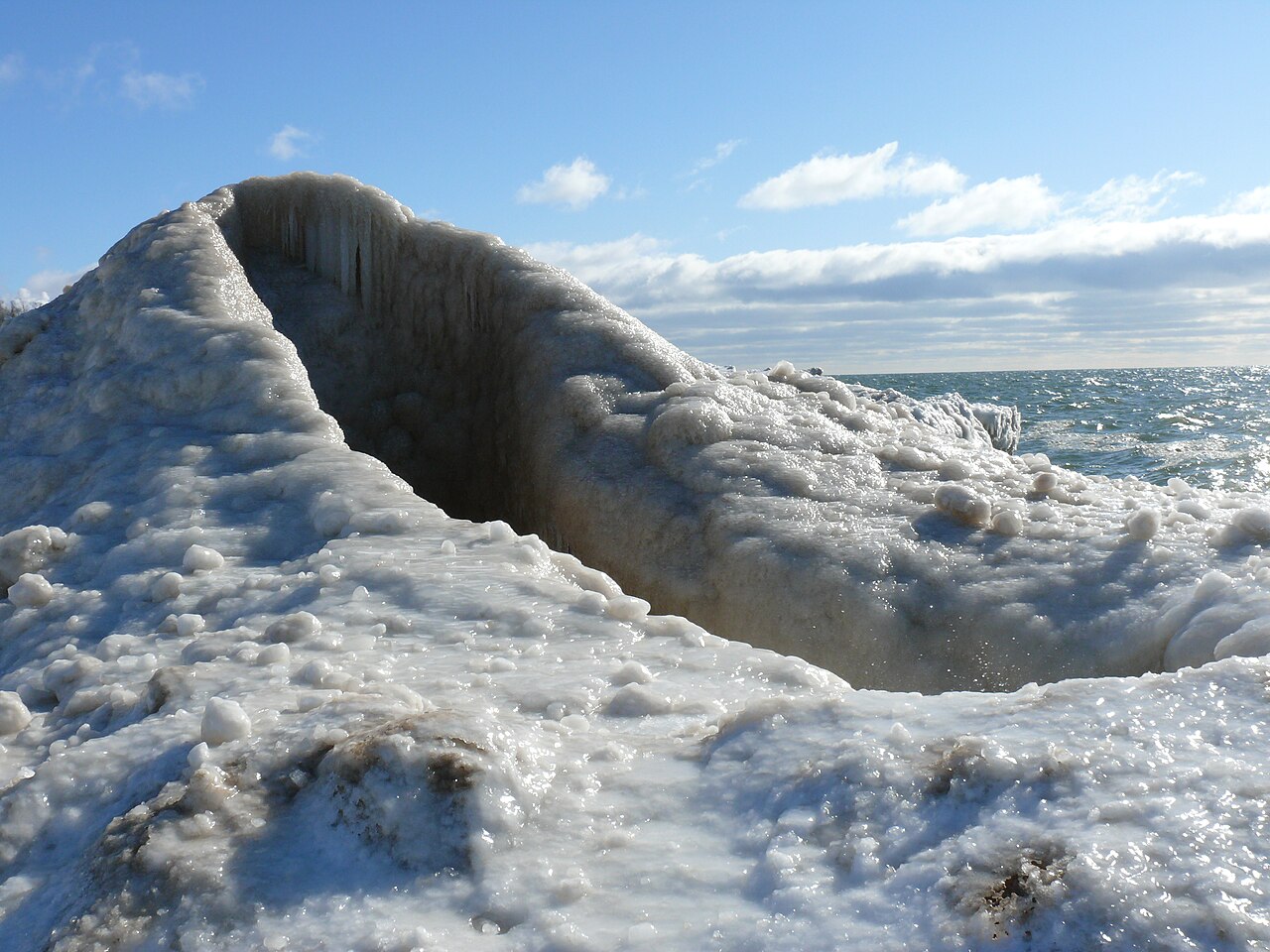
A brutal Arctic blast has turned parts of the Eastern United States into a deep freeze, and along at least one frozen shoreline the cold has sculpted something that looks straight out of science fiction: a rare “ice volcano” rising out of the shelf ice. The cone, built entirely from wind-whipped spray and frozen waves, has quickly become a magnet for photographers and curious locals braving subzero wind chills. Though it resembles a frozen eruption, the feature is really a fleeting side effect of a powerful winter storm pattern that is only just getting started.
Scientists and park officials say this kind of formation thrives when bitter air, strong winds and open water line up just right, a combination that has been common during the current cold snap. Similar cones have already popped up along Lake Michigan and in Upstate New York earlier this year, hinting that the Great Lakes and nearby rivers are entering prime season for these icy spectacles.
How a bitter cold snap built a towering cone of ice
The current deep freeze gripping the Eastern United States has delivered exactly the mix of ingredients that ice volcanoes love: frigid air, punishing gusts and just enough open water to keep waves punching through the ice. Meteorologists tracking the outbreak describe an Arctic air mass that dropped temperatures into the single digits in spots while wind chills plunged well below zero, conditions that help waves flash-freeze as soon as they hit the shoreline. An Analysis of the pattern warns that this historic chill could persist deep into February 2026, which means the atmosphere is not done sculpting the ice just yet.
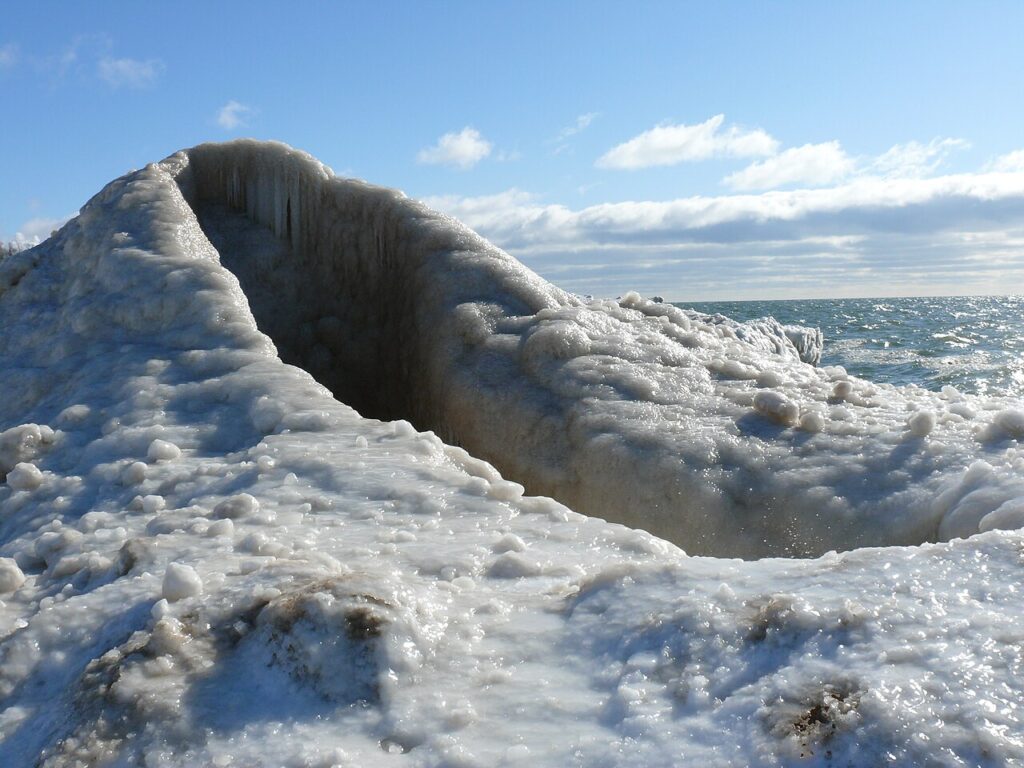
Along one exposed stretch of shoreline, those same winds have been strong enough to drive waves under and through the shelf ice, carving a vent that behaves like a natural fountain. As spray and slush shoot up through that opening, they freeze in midair and on contact, gradually stacking into a cone that now looms over the surrounding lake ice like a frozen geyser. A separate report on a similar feature described a Giant and TOWERING cone that formed during a bitter cold period, underscoring just how large these structures can grow when storms line up over several days.
What exactly is an “ice volcano” anyway
Despite the nickname, an ice volcano has nothing to do with lava or magma and everything to do with waves and wind. Geoscientists describe it as a cone of ice that grows around a hole in the shorefast ice, built as water repeatedly erupts through the opening and then freezes around the rim. One detailed explainer notes that along the Great Lakes, water first freezes on the surface, then waves driven by strong winds cut through that ice and send plumes of water and slush upward, slowly building the cone around an existing hole.
Researchers emphasize that the process is wave-driven rather than geothermal, which is why these features tend to cluster along windy coasts instead of volcanic hot spots. A reference on ice volcano mechanics notes that wind provides the energy for waves to punch through the ice and create formations that only loosely resemble true volcanoes, and that the cones are not hydrothermal at all. The result is a structure that looks dramatic in photos but is really a fragile, temporary monument to a very specific set of winter conditions.
From Silver Beach to Sodus Point, a season of icy eruptions
The current cold season has already produced a string of photogenic cones across the region, suggesting that the latest formation is part of a broader pattern. At Silver Beach County Park in St. Joseph, Michigan, photographer Joshua Nowicki captured a striking Ice Volcano on Jan 19, 2026, where the cone rose from the shelf ice just off the Lake Michigan shoreline. The post from Joshua Nowicki Photography shows the structure framed against a muted winter sky, with St. Joseph’s pier and lighthouse helping to convey just how tall the frozen mound had become.
Farther east, frigid air rolling over Lake Erie has been busy carving its own icy vents. A local station highlighted Ice “volcanos” forming at Sodus Point as temperatures hovered around 10 degrees, well below zero once the wind chill kicked in. That same shoreline, identified in search results for Sodus Point, has a history of wild winter surf, so the appearance of icy cones there fits the script of a lake that rarely stays quiet when Arctic air settles in.
Upstate New York’s fountain that turns into a frozen volcano
While the shelf ice cones grab social media attention, Upstate New York has its own twist on the phenomenon at Letchworth Park. There, a manmade fountain outside the Glen Iris Inn shoots water into the air all winter, and when a cold snap arrives the spray freezes into a towering sculpture that visitors have nicknamed an ice volcano. A feature on how this unique display forms in Letchworth Park notes that the fountain has grown into one of the park’s top winter attractions, with the cone often glowing blue-green as layers of ice build up around the spout.
Locals track its return each season, and recent coverage confirmed that the ice volcano is back at the park again. A report from Geneseo, NY described how the cone outside the Glen Iris Inn had already taken shape by early February, with Geneseo residents waking up to see the fountain transformed into a solid column of ice. Another clip of Ice volcano images from Letchworth State Park shows the structure looming above the Middle Falls, reinforcing how a simple water feature can morph into a winter landmark when temperatures stay locked below freezing.
Great Lakes shores: beauty, danger and a crash course in physics
Along the open coasts of Lake Michigan and Lake Erie, the current cold snap has turned the shore into both a spectacle and a hazard. Video from South Haven shows a shelf ice volcano on Lake Michigan where You can see chunks of ice erupting out the top, recorded from the safety of the pier in South Haven. Another educational piece that cites a Live Science article explains how waves on Lake Michigan repeatedly blast through weak spots in the ice, and as each spray freezes, it gradually builds a cone-shaped structure that can look almost architectural.
Scientists and park rangers stress that the same forces that create these shapes also make the surrounding ice extremely unstable. A safety advisory from New York State parks points out that similar cones have formed at Hamlin Beach State Park in Monroe County and, and warns that the hollow spaces under shelf ice can collapse without warning, which can lead to death. A separate explainer on what ice volcanoes are notes that if someone walks too close to the vent, they might be standing over open water hidden by a thin crust of ice, a reminder that the best vantage point is often a solid pier or bluff rather than the cone itself.
More from Vinyl and Velvet:

Leave a Reply