

You watched a live Olympic interview turn personal when Sturla Holm Lægreid broke down and admitted he had cheated on his girlfriend moments after winning bronze. He confessed on air to an affair and said he had told his partner about it a week earlier, a revelation that left hosts and viewers stunned and shifted attention from the race to his personal admission.
This piece will unpack what he said during the NRK interview, how teammates and commentators reacted, and what the moment means for his public image and the Olympic biathlon community. Expect a clear timeline of the on-air confession, immediate reactions, and the fallout that followed.
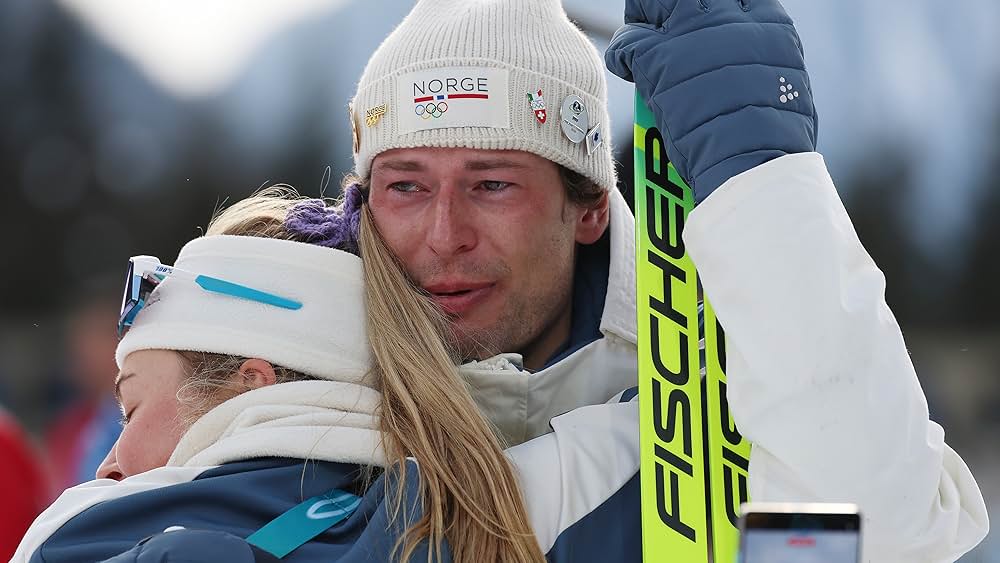
Sturla Holm Lægreid’s On-Air Confession
Lægreid used a post-event interview to make a personal admission that shifted attention from his bronze medal to his private life. The remarks played out live on Norwegian television and were widely shared by international outlets.
Details of the Emotional Live Interview
After winning bronze in the 20-kilometer biathlon, Sturla Holm Lægreid spoke with a reporter from the Norwegian Broadcasting Corporation (NRK) at the finish area in Anterselva. He tearfully said he had cheated on a partner three months earlier and described the guilt that affected his preparation. He did not name the person involved.
Lægreid framed the confession as an attempt to win back the person he called “the love of my life,” saying sport had felt secondary in recent days. He acknowledged the risk of public reaction — even calling the act “social suicide” — but said the emotional weight made him speak out immediately after the race. Video clips of the exchange circulated across broadcasters, including international coverage by outlets such as NBC.
Impact on Viewers and Hosts
Viewers reacted quickly on social media; many expressed shock that a medal interview turned into a personal confession. Live viewers and commentators paused mid-broadcast as Lægreid spoke, and broadcasters reran segments for context. The unexpected shift redirected headlines from Norway’s Olympic performance to his private admission.
Hosts and production teams faced an immediate editorial decision about how to handle follow-up coverage. Some outlets emphasized the sporting achievement, while others highlighted the human-interest angle and potential consequences for the athlete’s personal life and public image. The mix of sympathy and criticism in public responses reflected the tension between athletic accomplishment and personal accountability.
Explanation Behind the Public Admission
Lægreid later said guilt and the desire to repair a relationship motivated his public statement. He told NRK that he had confessed privately the week before but chose the post-race moment to signal remorse publicly, hoping it might help the relationship. He expressed uncertainty about whether the gesture would succeed.
He also said the emotional burden had affected his focus during competition. By speaking on live television, he accepted likely backlash and media scrutiny, framing the admission as a personal risk taken to make amends. Broadcasters and commentators have since debated whether the timing and platform were appropriate for such a disclosure.
Aftermath and Reactions Within the Olympic Biathlon Community
The confession prompted immediate public scrutiny, visible shifts in team dynamics, and no change to official race results. Reactions ranged from social-media commentary to private conversations among teammates and coaches at the Antholz–Anterselva venue.
Social Media and Public Response
Social platforms flooded with clips and commentary within minutes of the post-race interview. Clips of the moment circulated on X (formerly Twitter), generating thousands of replies that mixed criticism, bewilderment, and support for the athlete’s candor. Many posts referenced his status as a six-time world champion and recent World Cup performances when weighing the personal revelation against his competitive record.
Mainstream outlets summarized the incident and replayed excerpts, amplifying reach beyond biathlon fans. Public discussion often referenced the bronze medal at the 2026 Winter Olympics and compared the interview to other high-profile athlete interviews that crossed personal boundaries. Online sentiment analysis showed polarized reactions rather than a uniform backlash.
Effect on Teammates and the Norwegian Team
Team members reacted privately and publicly with measured responses at the Anterselva Biathlon Arena. Some teammates acknowledged awareness of the personal issue; others said they were surprised. Johan-Olav Botn, the gold medalist in the same event, noted the matter was largely personal and emphasized focusing on competition, a stance echoed by several Norwegian teammates.
Coaches and team officials emphasized support and mental-health resources while maintaining race-day focus. Inside the team, conversations centered on balancing personal support for the Norwegian biathlete with maintaining professional preparation for relay events and upcoming World Cup stages. The incident did not prompt disciplinary action reported by team staff, and training schedules and selection decisions for subsequent competitions remained based on performance metrics.
Athletic Achievements and Biathlon Results
The confession did not alter official standings: the athlete kept his bronze medal and World Cup points from the Milan–Cortina/Antholz–Anterselva period. Commentators reminded audiences that rifle shooting accuracy and skiing speed produced the podium finish despite personal turmoil. Analysts compared split times and shooting statistics to prior races to explain how he secured the Olympic medal.
Future selection for relay teams and World Cup events continued to hinge on measurable results — shooting percentage, ski speed, and recent podiums. His past record as a world champion and World Cup winner remained part of the competitive calculus. Staff and commentators noted that athletic form, not off-field issues, would determine whether he retained starts in upcoming biathlon World Cup stages.
More from Vinyl and Velvet:

Leave a Reply