

You’ll learn what happened when Turning Point USA’s All-American Halftime Show, headlined by Kid Rock, stopped streaming on X just hours before kickoff and why the switch matters for media, politics, and the Super Bowl’s cultural moment. The event was pulled from X late, forcing organizers to redirect viewers to other platforms amid licensing and distribution trouble that unfolded in real time.
Expect a clear timeline of the takedown, a look inside the All-American Halftime Show and Kid Rock’s controversial set, plus how social platforms and political backers reacted — from platform restrictions to artist dropouts and circulating rumors. This article traces those threads so you can follow what actually happened and why it sparked wide online debate.
Timeline: How Kid Rock’s Super Bowl Halftime Event Was Yanked From X
Turning Point USA planned a live counterprogram to the Super Bowl LX halftime slot, but licensing issues forced a last-minute move to YouTube and left fans scrambling for where to watch. The switch changed distribution, audience numbers, and how the group framed the event publicly.
Last-Minute Licensing Problems and the Switch to YouTube
Turning Point USA announced the stream would not run on X just hours before halftime, citing licensing restrictions that prevented airing on the platform. TPUSA described the decision as abrupt and outside its control, prompting organizers to redirect viewers to a YouTube stream instead.
The change affected technical setup and promotion. The team had to update promotional posts, change embedded players for partner pages, and alert viewers across social networks to the new link. That scramble likely reduced simultaneous viewership compared with a planned X broadcast.
Media reports and TPUSA messaging emphasized the licensing explanation while not disclosing contractual details. The switch also altered analytics: platform engagement metrics, monetization paths, and moderation controls differed between X and YouTube, which mattered for an alternative Super Bowl halftime show airing alongside the NFL’s official performance.
Initial Plans for the All-American Halftime Show
TPUSA promoted the “All-American Halftime Show” as a direct alternative to Bad Bunny’s Super Bowl halftime performance at Super Bowl LX. Kid Rock headlined, and the lineup included country and rock acts intended to appeal to conservative viewers who criticized the NFL’s choice.
Organizers timed the stream to run concurrently with the NFL’s halftime to capture viewers looking for counterprogramming. Turning Point leveraged its social channels and conservative media partners to push the event, announcing the lineup and branding it explicitly as a political-cultural response.
Logistics had mapped to a live X stream: expected bandwidth, talent call times, and synchronized start with the NFL broadcast. That plan shaped marketing and the decision to position the event as an “alternative Super Bowl halftime show,” signaling a deliberate contrast to the official halftime spectacle.
Official Announcements and Fan Reactions to the Change
TPUSA posted updates explaining the platform change and provided the YouTube link, while some conservative figures amplified the message to keep viewers tuned in. Coverage noted that the move happened hours before kickoff, creating confusion among viewers who expected the stream on X.
Fans reacted across platforms with a mix of frustration and persistence. Some viewers followed the redirection to YouTube quickly; others expressed annoyance at last-minute changes and at perceived platform censorship, which TPUSA highlighted in its messaging.
Journalists tracked view counts and commentary, comparing the TPUSA stream’s audience to Bad Bunny’s official Super Bowl halftime numbers. Public figures and former athletes also weighed in, which kept the story visible even after the platform switch.
Inside the All-American Halftime Show
Turning Point USA’s counterprogramming ran longer than expected, featured country and rock performers, and included a tribute segment that displayed photos of Charlie Kirk.
Key Performers: Kid Rock, Brantley Gilbert, Lee Brice, Gabby Barrett
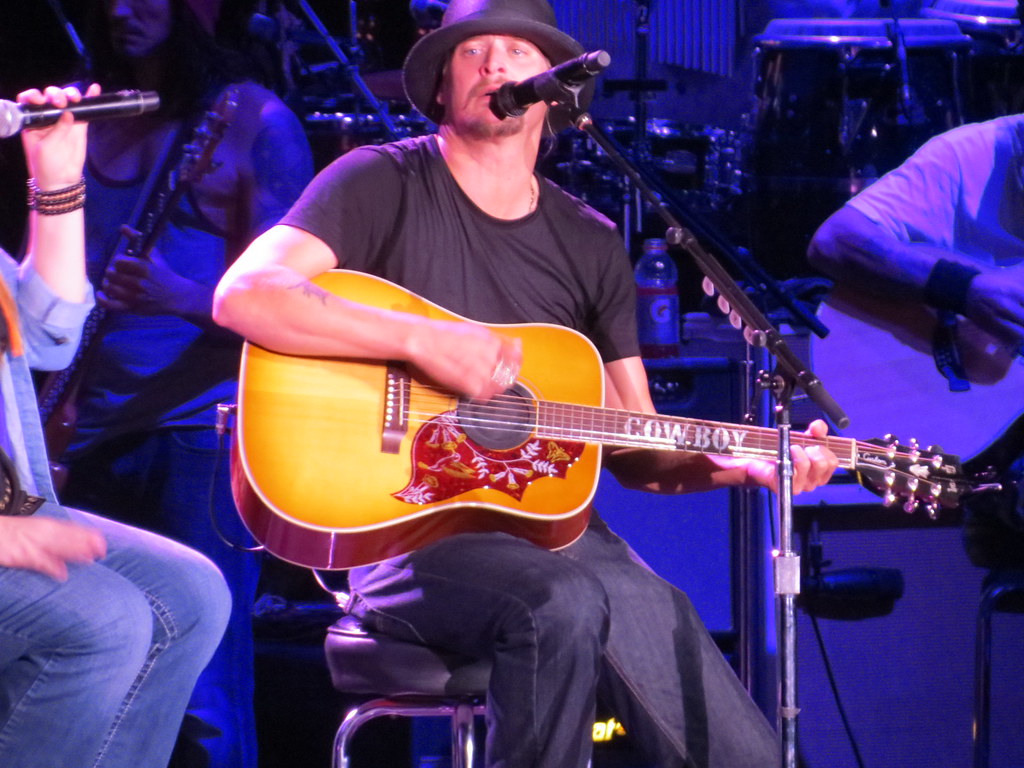
Kid Rock headlined the event, appearing in multiple outfits and alternating between electric rock and an acoustic tribute. He opened with high-energy guitar and pyrotechnics, then returned later for a softer, acoustic rendition of a country ballad while visuals honored Charlie Kirk.
Brantley Gilbert delivered a rowdy, amplified country set that matched Kid Rock’s hard-rock presentation. His stage presence emphasized rock-country crossover elements and crowd interaction.
Lee Brice performed with a traditional country arrangement and made remarks about free expression before his song, which drew attention for its political undertones.
Gabby Barrett provided a polished vocal opening, singing country-pop material that set a mainstream tone before the heavier rock and politicized moments that followed.
Setlist and Sequence of Events
The show ran roughly 30 minutes and began with country-oriented openers before transitioning to rock-driven numbers.
Gabby Barrett opened the lineup, followed by Lee Brice and Brantley Gilbert, each delivering two-to-three songs in 4–6 minute blocks. The pacing favored full-length performances rather than quick medleys.
Kid Rock’s set included an early electric number with heavy instrumentation, a mid-show classical-music interlude that briefly paused the momentum, and a later acoustic tribute performance.
The tribute segment concluded the setlist, with photos and clips of Charlie Kirk displayed across stage screens while Kid Rock performed the acoustic song.
Production Differences Compared to the Official Halftime Event
The All-American Halftime Show used an indoor, stadium-adjacent stage with a seated crowd of dozens, unlike the NFL halftime’s large, in-stadium production. Lighting and pyrotechnics were scaled for a smaller footprint and leaned on close-range effects rather than stadium-wide rigs.
There was no league broadcast or major streaming on X due to licensing, so the event relied on Turning Point’s own livestream infrastructure, which limited camera coverage and prevented integration with official shot lists and aerial staging.
Sound mixed for a live crowd rather than broadcast-first mastering, producing a more raw, front-of-house sound. Visuals emphasized portraits and recorded clips for the tribute segment rather than the choreographed spectacle typical of the Super Bowl halftime.
Kid Rock’s Performance: Highlights and Controversies
Kid Rock’s set mixed old hits, country covers and a short tribute; the performance drew attention for a possible lip-sync and a late-night homage to Turning Point USA’s founder. Viewers and critics focused on the energy of the opening numbers, technical questions about his vocals, and the choice of a contemporary country cover to close.
Bawitdaba and the Lip-Sync Debate
Kid Rock opened with high-energy material including his 1999 track “Bawitdaba,” which set a raucous tone and drove most of the immediate online reaction. Some viewers praised the familiar call-and-response hooks and the crowd interaction captured on the stream.
Within minutes of the set people noticed moments where his mouth movements did not align perfectly with the vocal track. That mismatch sparked claims of lip-syncing across social platforms and music blogs.
Kid Rock later disputed that narrative, pointing to technical issues and pre-recorded backing tracks commonly used in broadcast settings. Independent observers and a few outlets documented both the apparent synchronization problems and the broader context of amplified pre-recorded elements in televised events.
Covering Til You Can’t in Tribute to Charlie Kirk
He closed the roughly 30-minute set with a cover of “’Til You Can’t,” a recent country hit associated with Cody Johnson, choosing it as the finale. The performance framed the song as a tribute, paired with visuals honoring Charlie Kirk, the late founder of Turning Point USA.
Using a contemporary country ballad gave the finale a melodic contrast to the earlier rock-heavy numbers. Fans noted the emotional shift on social feeds, while critics questioned the song choice as politically symbolic given the event’s organizers.
The tribute video and song selection amplified discussion about the show’s purpose: entertainment, political messaging, or both. Reactions split between viewers who found the tribute sincere and those who saw it as overtly partisan staging.
Live or Pre-Recorded? Breaking Down the Claims
Claims about whether Kid Rock sang live centered on three factors: audible backing tracks, on-camera mouth-sync timing, and technical setup for a streamed counter-programming event. Multiple clips circulated showing moments where the vocal line and lip motion diverged.
Industry norms complicate the issue: many televised or large outdoor performances use backing tracks, in-ear monitors, and vocal reinforcement to ensure a stable broadcast. Kid Rock’s team cited rehearsal and playback configurations when addressing the controversy.
Independent commentators compared the event to televised halftime norms and noted that the presence of backing tracks alone doesn’t prove full lip-syncing. Still, the visible discrepancies and his subsequent statements kept the debate alive and shaped post-show coverage.
Social Media Reactions to the Yanked Event
Accounts across platforms lit up within minutes, with clips, commentary, and claims spreading fastest on X and Instagram. Threads blamed everything from technical failure to sabotage while supporters and critics traded screenshots and short-form videos.
Viral Moments and Memes
Short clips showing onstage audio mismatches circulated widely on X, drawing millions of views and a steady stream of memes. Users paired those clips with captions accusing the production of lip-syncing or poor sound mixing, which amplified ridicule across other apps.
Instagram reels repackaged the same footage with reaction faces and text overlays, helping the content reach non-X audiences. Memes referenced past pop-culture mishaps and used hashtags that trended regionally for hours. Even accounts on Truth Social reposted clips, though they framed them as evidence of a targeted smear rather than a technical issue.
Kid Rock’s Responses and Defenses
Kid Rock posted brief statements denying lip-syncing allegations and framed criticism as politically motivated. He thanked fans for support and pointed followers to behind-the-scenes clips meant to show live vocals and soundchecks.
His team released short video snippets on Instagram to highlight band performance and mic checks, and they pushed a statement on X emphasizing that parts of the televised feed were pre-recorded for safety and timing. Opponents labeled those explanations inconsistent, which kept the story alive in timelines and comment threads.
Fan Theories and Technical Explanations
Commenters offered several competing explanations: some claimed deliberate censorship, others blamed a botched livestream encoder or a lost audio feed. Technical-minded users pointed to common live-broadcast issues like latency between camera and FOH mixes and pre-recorded backing tracks used for staging.
Rumors labeling the situation as “fake news” spread alongside more plausible troubleshooting threads that cited latency, IFBs, and split feeds. On Truth Social and fringe pages, speculation skewed toward sabotage; on X and Instagram, threads tended to parse waveform artifacts and crowd noise to support or debunk those claims.
Comparing the Official and Alternative Halftime Broadcasts
Bad Bunny’s halftime delivered a large, polished spectacle on NBC with global pop collaborators and massive audience numbers. The Turning Point USA alternative led by Kid Rock targeted a conservative audience, streamed primarily on social platforms and right-leaning networks, and faced last-minute platform removal that altered its distribution.
Bad Bunny vs. Kid Rock: Audience, Style, and Criticism
Bad Bunny’s Super Bowl LX halftime show focused on high production values, choreography, and guest appearances, drawing mainstream and international viewers. NBC reported an average audience peak in the triple digits of millions, and the performance prompted widespread social and media conversation.
Kid Rock’s All-American Halftime Show emphasized country-rock numbers, patriotic themes, and conservative cultural appeals. It streamed on Turning Point USA channels and conservative outlets, and amassed millions of views on YouTube shortly after the event. The alternative show drew a different demographic profile than the NFL broadcast, with more concentrated conservative engagement.
Criticism split along cultural and political lines. President Donald Trump publicly criticized Bad Bunny’s set on social channels, while some commentators questioned the motives of staging a partisan alternative during a national broadcast. Others pointed to artistic differences and audience preferences rather than politics when comparing the two performances.
Impact of the Switch on Ratings and Reach
When Turning Point USA’s stream faced removal from X hours before airing, distribution shifted to platforms like YouTube and niche conservative networks. That change forced rapid rebroadcast planning and likely reduced live concurrent viewership compared with a stable social feed, though the alternative still reached millions in delayed views.
Bad Bunny’s broadcast benefited from the NFL’s mainstream TV distribution and Peacock streaming, maintaining high simultaneous reach and postgame online views. Early Nielsen-like estimates and platform counts showed Bad Bunny’s set trending far higher in live audience figures than the alternative, while Kid Rock’s stream recorded substantial—but smaller—total views over the following day.
The removal episode highlighted platform control over emergent broadcasts and the vulnerability of ad hoc streams. It also underscored how different distribution models—linear TV plus major streamer versus independent online channels and partisan networks—produce different metrics: live concurrent viewers, total views, and cultural impact.
Turning Point USA’s Role and the Bigger Political Picture
Turning Point USA organized and streamed a counterprogrammed halftime show aimed at a conservative audience, promoted by high-profile figures and positioned as a cultural rebuttal to the NFL’s choice of Bad Bunny. The event blended music, political messaging, and a tribute to the organization’s founder.
Origins and Goals of the Alternative Halftime Show
Turning Point USA (TPUSA) conceived the event as a direct alternative to the NFL’s halftime headliner. The group announced the concert after Bad Bunny’s selection, framing the show as a response to what some conservatives called an unserious or un-American halftime choice. TPUSA booked country and rock acts, headlined by Kid Rock, to appeal to its base and to drive streaming viewership across conservative platforms.
TPUSA positioned the program as both entertainment and political signaling. Organizers emphasized patriotic themes and U.S.-focused performers, aiming to reclaim a cultural moment they felt was ceded. The live stream reached millions, and the event doubled as a rallying point for donors and activists aligned with TPUSA’s network.
Charlie Kirk’s Influence and Legacy
Charlie Kirk founded Turning Point USA and built it into a national youth-oriented conservative group known for campus activism and media events. His leadership shaped TPUSA’s strategy of culture-war engagement and high-visibility stunts, which culminated in events like the halftime counterprogramming. Kirk’s profile helped attract performers, funders, and the audience that tuned in.
TPUSA’s memorial content at the event underscored Kirk’s role in defining the group’s identity. Participants treated the show as part entertainment, part institutional legacy-building—keeping Kirk’s messaging alive through music, visuals, and speeches that echoed his long-standing critiques of mainstream cultural institutions.
Patriotism, Culture Wars, and Audience Divides
The event leaned heavily into patriotic visuals and rhetoric, opening with anthems and sets drawn from country and classic-rock palettes. TPUSA used those symbols to contrast its program with Bad Bunny’s Spanish-language performance, framing language and cultural style as central to the dispute. That framing amplified existing audience divides over representation, nationality, and what constitutes “American” entertainment.
Critics said the counterprogramming politicized a traditionally apolitical spectacle, while supporters praised its appeal to conservative viewers and its ability to mobilize a distinct audience. The episode highlighted how culture-war tactics now intersect with live entertainment, turning a sporting halftime into a contested media moment that reflected broader partisan splits.
Related Fallout: Rumors, Tour Cancellations, and Artist Dropouts
Several high-profile departures and event cancellations followed the halftime controversy, with artists citing concerns about political division and potential backlash. Local organizers and fans faced sudden changes to schedules and lineups that affected ticketing and community plans.
Rock the Country Tour’s Anderson Stop Rumors
The Anderson, South Carolina stop of Rock the Country was canceled after multiple performers withdrew, officials said. County leaders told local media they learned of the cancellation on Feb. 5, and organizers cited artist exits that made the multiday event untenable.
Local officials had expected significant economic impact from the July dates, and cancellation notice came late enough to disrupt planning. Reports linked the pullouts to political tensions surrounding the festival’s association with Kid Rock and conservative groups. The cancellation left vendors, ticket holders, and county administrators scrambling for refunds and contingency plans.
Shinedown, Morgan Wade, Carter Faith, and the Lineup Shuffle
Several acts publicly exited the tour before Anderson was canceled. Rock band Shinedown explicitly said it was stepping away to avoid deepening political division, while Morgan Wade and Carter Faith were also reported to have left the lineup. Those departures triggered further changes to scheduling and promotional material.
The domino effect accelerated when additional artists declined participation, shrinking the roster that had been marketed as a cross-genre country-rock bill. That lineup shrinkage prompted organizers to cancel specific dates rather than try to fill slots at short notice. Fans who bought tickets faced uneven communication about refunds and rescheduled shows as the tour’s credibility took a hit.
More from Vinyl and Velvet:

Leave a Reply