

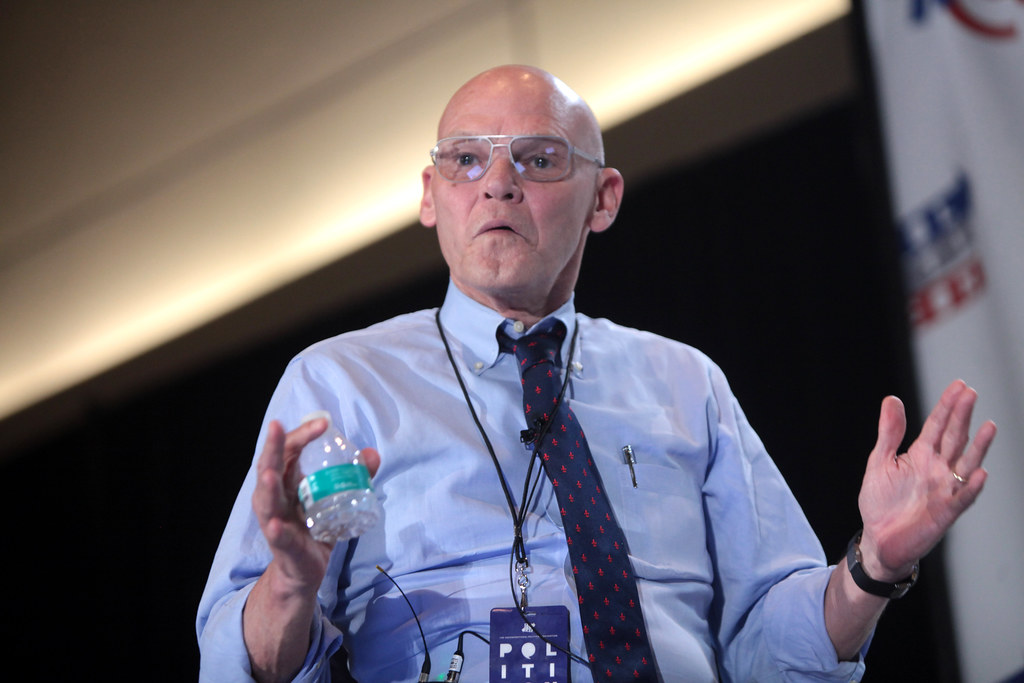
James Carville has never been shy about telling Democrats what he really thinks, and he is already looking past the current cycle to the fight to succeed President Donald Trump in 2028. Asked who should carry the party’s banner next time, the veteran strategist is pointing not to a familiar Washington face but to a Midwestern governor with a big checkbook and an even bigger appetite for campaigning. In Carville’s view, Illinois Gov. JB Pritzker is not just a name to watch, he is the strongest option Democrats have for their next presidential nominee.
That choice instantly reshapes how insiders talk about the coming primary, which is widely expected to be crowded and bruising. It also puts Vice President Kamala Harris on notice, since Carville is just as blunt about who he thinks should not be anywhere near the top of the ticket.
The 2028 stakes and Carville’s surprise favorite
Carville is looking at 2028 as a reset moment for a party that has spent years defining itself in opposition to President Donald Trump, who is now term limited and will be leaving office at the end of his second term. The coming Democratic nomination battle to replace him is expected to draw a wide field of ambitious contenders, all vying to prove they can win back the White House after Trump’s tenure and carry the flag into a new political era, a scenario laid out in early Democratic chatter. Against that backdrop, his decision to single out one governor so early is a signal that he thinks the party cannot afford another muddled, drawn out identity crisis.
Instead of gravitating to the usual national figures, Carville is putting his chips on Illinois Gov. JB Pritzker, a billionaire executive who is already running this year for a third term to steer Illinois and has quietly built a national profile. In interviews, he has argued that Pritzker is the party’s strongest option for 2028, describing him as the Democrat worth watching and stressing that the governor “campaigns hard,” a point echoed in reporting that notes how Illinois Gov JB Pritzker has already started to look beyond Springfield. For a strategist who helped engineer past Democratic wins, that kind of early, enthusiastic endorsement is not casual name-dropping, it is a deliberate attempt to shape the field.
Why Pritzker checks Carville’s boxes
Carville’s case for Pritzker starts with something simple: he thinks the governor knows how to grind. He has praised Pritzker as someone who “campaigns hard,” a compliment that carries weight coming from a strategist who has spent decades watching candidates wilt under the pressure of a national race. Coverage of the governor’s political operation has highlighted how the billionaire has poured time and money into building a durable state machine and is now seen as a serious contender for the 2028 Democratic presidential nomination, with allies arguing that the Democrat James Carville is simply saying out loud what many insiders already suspect.
There is also a stylistic fit. Carville has always favored candidates who can throw a punch and take one, and Pritzker has shown a willingness to mix it up with Republicans, including direct clashes with President Donald Trump over issues like deploying National Guard troops in Chicago, a confrontation that underscored how the National Guard debate can become a proving ground for national ambitions. For Carville, that kind of high profile sparring, combined with a record of winning statewide in a big, complex state, makes Pritzker look less like a regional figure and more like a ready made national standard bearer.
Harris, 2024 baggage and the voters Carville wants
If Carville’s praise for Pritzker is glowing, his assessment of Kamala Harris is ice cold. Asked whether he could see Harris as the party’s standard bearer in 2028, he has been quoted saying she has “no chance,” arguing that no Democrat wants anything to do with anybody who had anything to do with 2024 and that the base is ready to move on from that entire chapter. In one sharp line, he summed up the mood by saying voters do not want to give a “s—” about relitigating that race, a sentiment captured in coverage of how No Democrat in his telling is eager to rehash that campaign.
That critique is not just personal, it is strategic. Carville is effectively warning that anyone too closely tied to the 2024 ticket will carry baggage into a race that should be about the future, not a rerun of old fights with Trump. When he rules out the sitting vice president and instead points to a governor who has been building his own brand in Illinois, he is signaling that the party’s path back to the White House runs through fresh faces who can talk about new fights, not just defend old records, a view that has been amplified in pieces that say he has rules out Dem options tied too tightly to that earlier race.
Inside the Carville–Pritzker alliance of convenience
Carville’s interest in Pritzker is not happening in a vacuum. The strategist has been making the rounds in political media, weighing in on who he thinks could lead Democrats in 2028 and using his platform to nudge donors and activists toward his preferred profile of candidate. In one widely discussed appearance, he laid out his surprise prediction for the next Democratic standard bearer and framed it as a wake up call for a party that needs to think harder about who can actually win, a message that has been echoed in coverage of his political prediction.
For Pritzker, the attention is a mixed blessing. On one hand, being anointed by James Carville instantly elevates him from regional power broker to national prospect, reinforcing reporting that describes how James Carville now openly calls him a strong choice for a 2028 run. On the other hand, it also paints a target on his back, inviting scrutiny from rivals who will be eager to frame him as the pick of the establishment and to question whether a billionaire governor is really the right messenger for a party that talks constantly about inequality.
The broader Democratic field and what comes next
Carville’s endorsement of Pritzker lands in a moment when Democratic heavyweights are already turning heads and sparking 2028 speculation, even as they insist they are focused on their current jobs. Governors, senators and cabinet members are quietly testing messages, building donor lists and visiting early primary states, all while watching to see whether a consensus favorite emerges or the party stumbles into another free for all.
Within that swirl, Carville’s insistence that Pritzker is the party’s strongest option functions as both a prediction and a dare. He is effectively challenging other would be contenders to prove they can match the Illinois governor’s combination of resources, toughness and willingness to confront Republicans, including his high profile sparring with President Donald Trump over the National Guard. As more Democrats float their own favorites and test the waters, the question is whether Carville’s early bet on Pritzker becomes a self fulfilling prophecy or simply the opening argument in what promises to be a long, loud fight over the party’s future.
More from Vinyl and Velvet:

Leave a Reply