

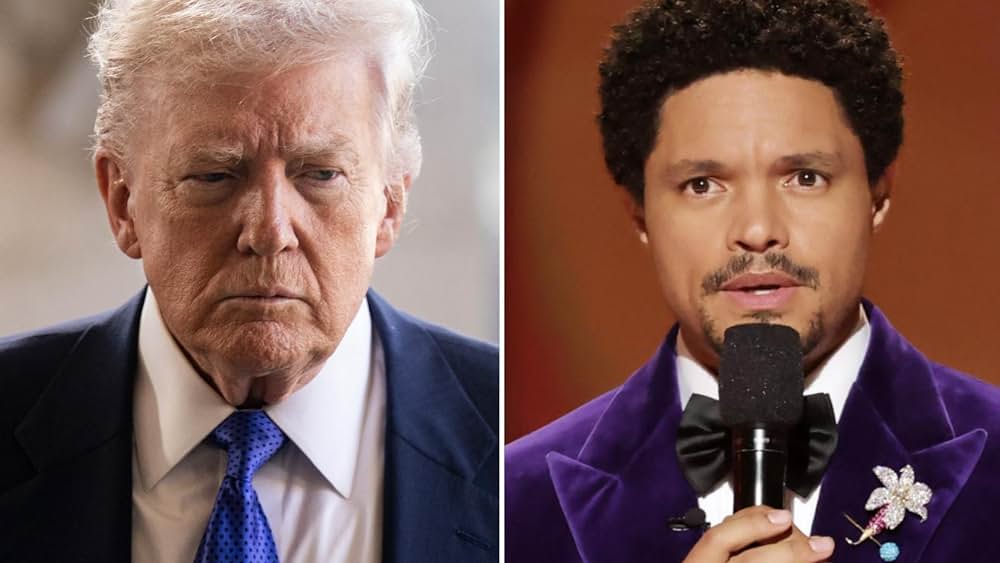
President Donald Trump is once again turning an awards show joke into a political flashpoint, this time threatening to sue Trevor Noah over a Grammys punchline about Jeffrey Epstein’s private island. What started as a quick gag during music’s big night has spiraled into a full-blown clash between the White House and one of comedy’s most prominent voices, with Trump insisting the bit was defamatory and Noah’s defenders calling it standard-issue satire.
The fight drops Trump, Noah, Epstein and the Grammys into the same combustible sentence, and it is already rippling far beyond the stage. It is about where the legal line sits for jokes that touch on real scandals, how much power a sitting president should wield over cultural critics, and whether the Epstein story has become too hot for even late-night style humor to handle.
How a Grammys one-liner lit the fuse
The spark came during the Grammys on Sunday, when host Trevor Noah folded Trump and Bill Clinton into a joke about Jeffrey Epstein’s infamous island. In a bit that played off the newly released Epstein documents and the long-running speculation around who visited the financier’s Caribbean retreat, Noah teased that Trump and Clinton had “hung out” there, a line that immediately set off alarms in Trump world and delighted a crowd used to presidents being the butt of awards show humor. Reporting on the show notes that the South African comic was already leaning into political material, and that the Epstein reference was the one that clearly crossed a line for the president.
Coverage of the telecast describes how Noah, a former Daily Show host, used the Grammys stage to riff on the culture of celebrity scandal, then pivoted into the Epstein material that linked Trump and Clinton to the island in a way Trump insists is false. Accounts of what Noah said emphasize that the joke implied a shared presence on Epstein Island, even as the host kept the tone light and moved quickly on to other targets. A detailed breakdown of the bit explains that the line about Trump and Clinton seemed to draw Trump’s ire more than Noah’s other digs at powerful men, including references to recent arrests and industry scandals that were sprinkled throughout the monologue.
Trump’s rapid-fire backlash and lawsuit talk
Trump did not wait long to fire back. Shortly after the Grammys wrapped, he took to his social media platform, Truth Social, to blast the show as “virtually unwatchable” and to single out Noah’s Epstein line as “false and defamatory.” In that post, he threatened legal action, saying he intended to sue the comedian and accusing him of spreading lies that connected him to Jeffrey Epstein’s island. One account of the reaction notes that Trump’s message framed the awards as part of a broader cultural decline, but the sharpest language was reserved for the host who had just mocked him in front of millions of viewers.
Follow up reporting on Trump’s response quotes him insisting that he has “never been to Epstein Island, nor anywhere close,” language that he later echoed in other venues as he tried to shut down speculation about his ties to the late financier. In one detailed write up, Trump is quoted saying, “I can’t speak for Bill, but I have never been to Epstein Island, nor anywhere close, and until tonight’s false and defamatory statement, no one had ever suggested that I had ever visited his island,” a formulation that both distances him from Bill Clinton and underlines his legal threat. Another account of the Truth Social post highlights how Trump promised he was “going to have some fun” with Noah in court, a phrase that captured his mix of grievance and showmanship as he vowed to sue the comedian for plenty.
What Trump says about Epstein, Clinton and the island
At the core of Trump’s anger is his insistence that the joke invented a connection that does not exist. He has acknowledged knowing Jeffrey Epstein socially years ago, but he now stresses that he banned Epstein from Mar-a-Lago and that he never set foot on the Caribbean island that became shorthand for the financier’s abuse. In his latest statements, Trump has been careful to draw a bright line between himself and Bill Clinton, saying he cannot speak for “Bill” while repeating that he has never been to Epstein Island and that no credible report has ever placed him there. That distinction is crucial to his claim that Noah’s joke crossed from satire into defamation.
Reports summarizing the newly released Epstein files note that the documents have reignited public scrutiny of who flew on Epstein’s planes or visited his properties, but they also underline that the records do not show Trump traveling to the island itself. One political analysis points out that a representative for Clinton did not immediately respond to questions about the joke, leaving Trump to fill the vacuum with his own narrative about what the documents do and do not say. Another explainer on the controversy walks through the question “Did Trump go to Epstein’s island?” and concludes that while Trump’s name appears in some Epstein-related materials, there is no evidence he visited the Caribbean property, a gap that Trump’s allies say makes Noah’s punchline a reckless leap. That same coverage notes that Epstein’s island in the Caribbean has become a symbol of elite impunity, which helps explain why any suggestion of a visit lands with such force.
Noah’s joke in context: comedy, politics and a live mic
For Trevor Noah, the Grammys gig was familiar territory, a high-wire mix of music fandom and political ribbing that he has honed over years behind a late-night desk. Accounts of the show describe how he threaded references to President Donald Trump, Nicki Minaj and Diddy into a broader commentary on fame and accountability, using the Epstein material as one of several pressure points. The bit that mentioned Trump and Bill Clinton hanging out on the island was delivered with the same dry tone he used for other targets, which supporters say makes it clear he was operating in the realm of exaggeration and innuendo that awards show hosts have long relied on.
Entertainment reporters who watched from the room note that the audience reacted with a mix of laughter and gasps, the kind of response that tells a comic they have hit a nerve. One recap of the telecast points out that Noah’s line about Trump and Clinton came after he had already joked about the Grammys being the last time the show would be broadcast on its longtime network, a sign that he was comfortable poking at both the industry and its political overlords. Another piece on the night’s standout moments highlights how Noah, a South African performer who has built a career on dissecting American politics, used the stage to remind viewers that the Epstein story is still unresolved, even if the punchline that connected Trump to the island is now at the center of a potential lawsuit. A separate analysis of the joke notes that the question “What did Trevor Noah say?” has become a shorthand for the entire dust up, as clips of the moment circulate online and are replayed in segments that break down the Grammys fallout.
From Truth Social to the briefing room: the political fallout
Once Trump’s Truth Social post landed, the story quickly migrated from entertainment pages to the political beat. Reporters pressed President Donald Trump about the threat at a subsequent appearance, asking whether he actually plans to sue the 2026 Grammys host Trevor Noah. In one televised exchange, Trump dodged the question, pivoting to complaints about media bias and the unfairness of awards shows, even as he repeated that the joke was “WRONG!!!” and that he had never been to the island. The moment underscored how a single awards show quip can end up shaping the White House message of the day, with aides fielding questions about a comedian instead of policy.
More from Vinyl and Velvet:

Leave a Reply