

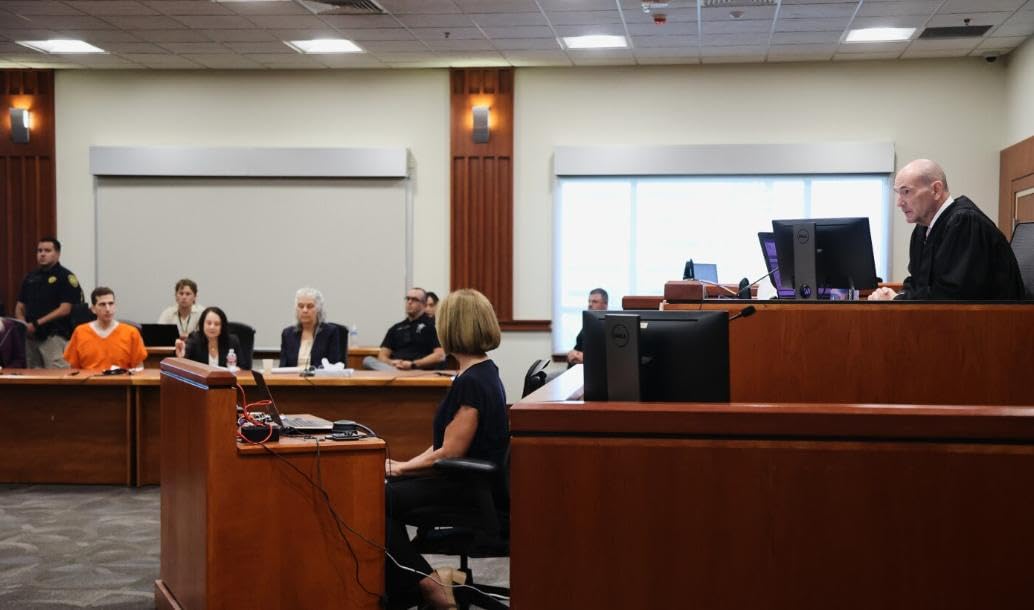
The newly unsealed court filing in the Idaho student killings does more than add another grim detail to an already horrific case. It lays out a forensic theory that Bryan Kohberger did not rely on a single knife when he attacked Kaylee Goncalves, but instead used a second weapon while stabbing her more than two dozen times. That allegation, coming from a defense expert and now seized on by the Goncalves family, is reshaping how the public understands what happened inside the King Road house in Moscow, Idaho.
It is also colliding with the legal reality that Kohberger has already avoided the death penalty and been sentenced to life in prison. As families push for answers about why Kaylee suffered different injuries from the other victims, the second‑weapon claim is becoming a flashpoint in their broader fight over transparency, accountability, and what justice looks like after the verdict.
The second weapon theory and what the filing actually says
The core of the new revelation is straightforward but chilling: a forensic pathologist working with Kohberger’s own defense team concluded that more than one weapon was used on Kaylee Goncalves. In the unsealed filing, that expert said Bryan Kohberger used a second weapon while stabbing Kaylee Goncalves over 24 times, pointing to injuries that did not match a single knife profile and suggesting multiple types of lethal force were involved in the attack. The document, which has now been made public, is the first time this specific theory has been laid out in such detail, and it immediately raised questions about how much more violence Kaylee endured compared with the others.
The filing describes Kaylee as suffering extensive sharp‑force injuries along with trauma that did not line up neatly with a single blade, which is why the expert concluded that multiple weapons were used against her. That assessment is echoed in a separate summary that notes the same defense expert’s view that Bryan Kohberger used two weapons to brutally murder one of the victims, citing the combination of deep stab wounds and other lethal injuries that could not be explained by a lone knife. Prosecutors, according to the filing, did not adopt that theory in their own narrative of the crime, but they did not fully refute the underlying forensic observations either, leaving the second‑weapon claim hanging in a tense middle ground between defense analysis and the state’s official case.
Why Kaylee’s injuries stand apart from the other victims
From the start, investigators have said that four University of Idaho students were killed at an off‑campus house on King Road in Moscow, Idaho, in November 2022, and that all four were stabbed. Yet the newly unsealed material underscores that Kaylee’s injuries were not like the others. She is described as the only one of the four victims to have suffered both sharp‑force trauma and injuries consistent with blunt force and asphyxial mechanisms, including damage to the teeth and tongue that suggested a separate kind of attack layered on top of the stabbing. That combination is a key reason the defense expert zeroed in on the idea of a second weapon, arguing that the pattern of wounds simply did not match a single instrument.
Other records back up the sense that the violence against Kaylee was especially ferocious. One set of police documents notes that “Madiso” Mogen appeared to be lying on the bed with significant stab wounds and that a lot of force was used, but even in that context, Kaylee’s injuries are described as uniquely severe. Another trove of unsealed documents recounts how Kohberger proceeded to savagely knife Goncalves more than 20 times, leaving her “unrecognizable” in a pool of blood in a second‑floor bedroom, a description that tracks with the later forensic claim that she was targeted with multiple forms of lethal force. Taken together, the records paint a picture of Kaylee as the victim who bore the brunt of the attack, both in the number of wounds and in the variety of trauma inflicted.
How the Goncalves family and their lawyer are using the claim
For Kaylee’s relatives, the second‑weapon theory is not an abstract forensic debate, it is a concrete explanation for why their daughter’s injuries looked different when they were finally allowed to see the autopsy material. The attorney for the Goncalves family has publicly argued that Bryan Kohberger used a second weapon in the murders, pointing to the blunt force and asphyxial injuries to Kaylee’s face as evidence that something beyond a single knife was involved. In a separate interview, that same lawyer framed the new filing as confirmation that the family’s long‑standing questions about Kaylee’s wounds were justified, saying the expert’s analysis matched what they had been told privately about the condition of her body.
The family’s push for answers has played out in emotional ways. In one short video clip, recorded after they were briefed by investigators, relatives described going into the meeting with a list of questions and coming out with the sense that some of their worst fears about the brutality of the attack had been confirmed. They have also leaned on the second‑weapon claim to argue that Kaylee was singled out, noting that she is the only victim whose face had blunt force injuries and whose mouth showed signs of asphyxial trauma, details that the lawyer says cannot be squared with a single knife attack. For them, the filing is less about helping Kohberger’s defense and more about documenting, in black and white, just how much their daughter suffered.
Inside the broader case: trial, plea deal, and life sentence
The forensic revelations are landing after the legal dust has largely settled. Earlier in the case, Judge Hippler tentatively set the start date for jury selection as August 4, 2025, with the jury trial beginning on August 18, signaling that the court was preparing for a long and complex proceeding. That plan changed when Kohberger opted to resolve the charges without going through a full trial, a decision that stunned some observers who had expected a drawn‑out courtroom battle over everything from DNA evidence to cell‑phone records. The shift meant that many of the most graphic details, including the second‑weapon theory, would surface through filings rather than live testimony.
By the time the case reached its endgame, the focus had turned to sentencing. In a hearing covered in extensive live updates, a Judge sentenced Idaho killer Bryan Kohberger to life in prison, after prosecutors agreed to take the death penalty off the table in exchange for his plea. Another account of the proceedings notes that Kohberger’s murder trial was abruptly canceled after he took a plea deal from prosecutors in Jul, a move that locked in multiple life sentences and avoided the risk of a capital verdict. Families of the University of Idaho victims used the sentencing hearing to describe their loss and to press the court on why the death penalty was no longer being pursued, underscoring how the legal outcome and the forensic horror of the crime have never quite felt aligned in their eyes.
What the new details mean for the families and the public
The second‑weapon claim is also rippling into other legal and public battles tied to the case. Relatives of the victims have already filed a civil lawsuit against Washington State University, where Kohberger had been a graduate student, arguing that the school missed warning signs and should bear some responsibility for what happened. In that suit, which has been detailed in recent coverage, the families point to the scale and brutality of the killings as part of their argument that institutional failures had devastating real‑world consequences. The more graphic and specific the forensic record becomes, the more fuel they have for that broader push for accountability beyond the criminal courtroom.
More from Vinyl and Velvet:

Leave a Reply