

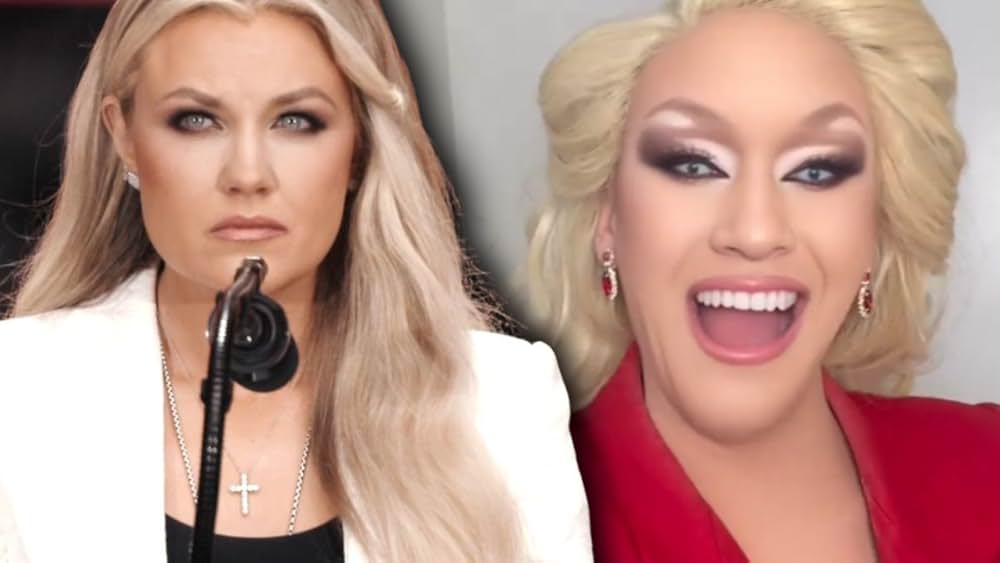
Drag performer Lauren Banall has turned a niche political wife into the internet’s favorite mirror for America’s weirdest culture war vibes. Her viral Erika Kirk impression is not just a dead-on character study, it is landing as sharp, crowd-pleasing commentary on the way conservative media packages femininity, faith, and fear.
By leaning into big hair, bigger eyes, and a script pulled straight from Erika Kirk’s own words, Banall has built a character that feels both absurd and uncomfortably familiar. The result is a drag act that doubles as a running critique of the current political moment, and audiences are treating it less like a meme and more like a weekly dispatch from the front lines of the culture clash.
The Viral Birth Of A Political Drag Phenomenon
The spark for all of this was a single performance that hit social feeds like a lightning bolt. In her first widely shared video, Banall appears in full glam as Erika Kirk, lip-syncing to Kirk’s own monologue with a locked, bug-eyed stare that turns every line into a punchline and a warning at the same time. That clip racked up 4.5 m views, a number that instantly pushed the act out of queer nightlife and into mainstream political discourse.
From there, the character snowballed into a full-blown phenomenon. Clips of Banall’s wild-eyed parody of Erika Kirk, who is married to Turning Point USA founder Charlie Kirk, started circulating as shorthand for a certain kind of right-wing media performance. Another report framed the act as a “wild-eyed” sendup that was not just going viral but also raising money to push back on MAGA politics, which is exactly where the impression starts to look less like simple mockery and more like a pointed political tool.
Lauren Banall, Erika Qwerk, And The Making Of A Memeable Icon
Part of what makes this moment so sticky is that it is not just one performer doing a one-off bit. Los Angeles based drag queen Lauren Banall has been building a following with performances cosplaying as Erika Kirk, and her handle @laurenbanall has become a hub for fans who treat each new video like the next episode in a serialized political satire. Her Erika is not a flat caricature, it is a recurring character whose exaggerated sincerity keeps reflecting back the logic of the real-world talking points she is lip-syncing.
At the same time, another drag queen performing under the name Erika Qwerk has stunned viewers with an uncanny Erika Kirk impression that leans even harder into the eerie resemblance. One viral clip shows Erika Qwerk channeling Kirk’s cadence so precisely that viewers joked it felt like watching the real Erika rehearse for her husband Charlie Kirk’s memorial service. Together, Banall and Erika Qwerk have turned one political spouse into a memeable archetype, a kind of drag shorthand for the polished, apocalyptic tone that defines a lot of conservative influencer content.
Feeling “Helpless And Gaslit” In 2026 Politics
Behind the lashes and the jokes, Banall has been blunt about why this character hit such a nerve. She has described feeling “helpless and gaslit” by the current political climate, where so many extreme statements are treated as normal that it can feel like reality itself is being edited in real time. In one interview, she put it plainly, saying that “so many things feel so insane, so not-normal, and it feels like no one is addressing it,” a sentiment that helps explain why audiences are clinging to a drag parody as a kind of sanity check on the news cycle.
Those comments are not just vibes, they are documented in reporting that tracks how Banall turned that sense of disorientation into a viral act. One piece on her Erika Kirk performances quotes Lauren Banall directly about this “insane” political moment, while another notes that she felt “helpless and gaslit” before she created the character that would eventually “break the internet.” That second report, which focuses on how the drag queen processed those emotions, underscores that the act was born less from a desire to dunk on one woman and more from a need to call out a broader pattern that “no one is addressing.”
When Drag Becomes A Fundraiser Against Power
What really shifts Banall’s Erika Kirk impression from viral joke to razor-sharp commentary is what she has done with the attention. Instead of just basking in the views, she has used the viral spotlight to raise money to fight back against President Donald Trump’s agenda and the broader conservative movement that Erika Kirk is aligned with. Reporting on her trajectory notes that the drag queen managed to turn the reactions she has garnered into a way to raise money to fight back against Presiden Trump, including a benefit event scheduled for March 4 at Precinct DTLA.
Banall has also been explicit about where some of that money is going. She has pointed to organizations that are already on the front lines of anti-drag and anti-LGBTQ legislation, saying that “They also have their Defense of Drag Fund, so it was a no-brainer to help them help us and other minorities that conservatives are targeting.” That reference to a Defense of Drag makes it clear that the Erika Kirk act is not just catharsis, it is a pipeline that moves money from viral outrage into concrete legal and political defense work.
Satire As A Response To Conservative Femininity
At the core of the impression is a very specific target: the polished, devotional, slightly haunted version of womanhood that conservative influencers like Erika Kirk often present. Banall’s performance exaggerates the wide eyes, the breathy emphasis on faith and family, and the constant undertone of looming crisis, turning them into a funhouse reflection of the real thing. That is why the character lands so hard, it is not inventing a new persona, it is simply turning up the volume on traits that are already there in Erika Kirk’s own public appearances.
Other drag performers have picked up on the same visual language. The viral clips of Erika Qwerk show a performer who has studied Kirk’s hair, makeup, and posture closely enough that viewers do a double take before the punchline lands. In that clip, the joke about rehearsing for Charlie Kirk’s memorial service is not just dark humor, it is a way of poking at the way some conservative branding leans on martyrdom and sacrifice. By putting that aesthetic into a drag context, the performers are asking audiences to look again at what they have been trained to see as wholesome or aspirational.
How Social Media Turned A Niche Bit Into A Movement
None of this would have mattered much without the algorithmic gasoline of social media. Banall’s Erika Kirk videos spread first through TikTok and Instagram Reels, where short, repeatable bits thrive. A widely shared reel from pride_site highlighted how @LaurenBanall was “serving illusion,” and the post’s 477 likes helped push the act into new corners of queer and pop culture feeds. That kind of amplification turned a local LA drag number into a recurring reference point for people who might never have heard of Erika Kirk otherwise.
Other platforms piled on. A Facebook video joking that the “erika kirk 2026 press run needs to be studied” framed the character as someone who is going to “dominate the media landscape in 2026,” a tongue-in-cheek way of acknowledging just how omnipresent the parody has become. That clip, shared by a user with the handle Dudewithcoolusername, treated the Erika Kirk act as a case study in how political wives and influencers are packaged for mass consumption, and the 2026 press run joke only works because viewers instantly recognize the media machine it is skewering.
Drag, Defense Funds, And The Stakes Of The Culture War
The timing of Banall’s rise as Erika Kirk is not accidental. In a year when drag performers are facing legislative attacks and moral panics, turning a conservative influencer into a drag character is both risky and strategic. Banall has leaned into that tension by explicitly tying her act to fundraising for groups that defend drag and LGBTQ rights, pointing to “They also have their Defense of Drag Fund” as a key reason she chose to partner with them. That line, captured in coverage of her work, underlines how the act is designed to push back against a wave of bills and rhetoric that paint drag as inherently dangerous.
Another report on her Erika Kirk act spells out how she has “managed to take the reactions she’s garnered and turn them into a way to raise money to fight back against” President Trump and the conservative movement aligned with him. The benefit show at Precinct DTLA, scheduled for March 4, is part of that strategy, a night where the same jokes that light up social media are used to fill a room and a donation bucket. By linking the viral character directly to a drag queen who felt “helpless and gaslit,” the coverage makes clear that the stakes are not abstract, they are about whether performers like Banall will have the legal and cultural space to keep doing this work.
Why The Internet Sees This As Razor-Sharp Commentary
What separates Banall’s Erika Kirk from a thousand other political memes is the precision of the impression. She is not just mocking a hairstyle or a dress, she is recreating the rhythm of Erika Kirk’s speech, the way her eyes widen on certain phrases, the soft but urgent tone that makes every sentence sound like a warning from a friend. That level of detail is why viewers describe the act as “uncanny” and why clips of Erika Qwerk and Banall both draw comments from people who say they had to double check that they were not watching the real Erika.
That accuracy is what turns the impression into commentary. When Banall lip-syncs Kirk’s own words about faith, gender, or politics, the audience is forced to confront how those ideas sound when stripped of the flattering context of a friendly podcast or a sympathetic stage. A write-up on the trend notes that “In 2026, politics feels more chaotic than ever, but Lauren Banall is showing that sometimes a wig and a joke can hit harder than a think piece,” a line that captures why so many people are treating the act as a kind of pop culture op-ed. By embodying Erika Kirk so completely, Lauren Banall lets the politics speak for themselves, and the laughter that follows is as much about recognition as it is about ridicule.
What This Says About 2026 Politics
Zoomed out, the Erika Kirk drag craze is a snapshot of where American politics sits in early 2026. The fact that a drag queen’s impression of a conservative influencer can rack up 4.5 m views and spawn copycats like Erika Qwerk shows how much of the political conversation has migrated into the realm of performance and parody. People are not just arguing about policy, they are remixing the personas of the people selling that policy, and drag has become one of the sharpest tools for doing that.
At the same time, the backlash to drag and the need for things like a Defense of Drag show that this is not a game for everyone involved. Banall’s decision to turn her “helpless and gaslit” feelings into a character that raises money to fight President Trump’s agenda is a reminder that satire is not just commentary, it is strategy. In a year when politics feels like a never-ending content stream, the Erika Kirk impression stands out because it uses that same content logic to push back, turning a viral joke into a sustained, pointed critique of who gets to define morality, femininity, and power in the first place.
More from Vinyl and Velvet:

Leave a Reply