

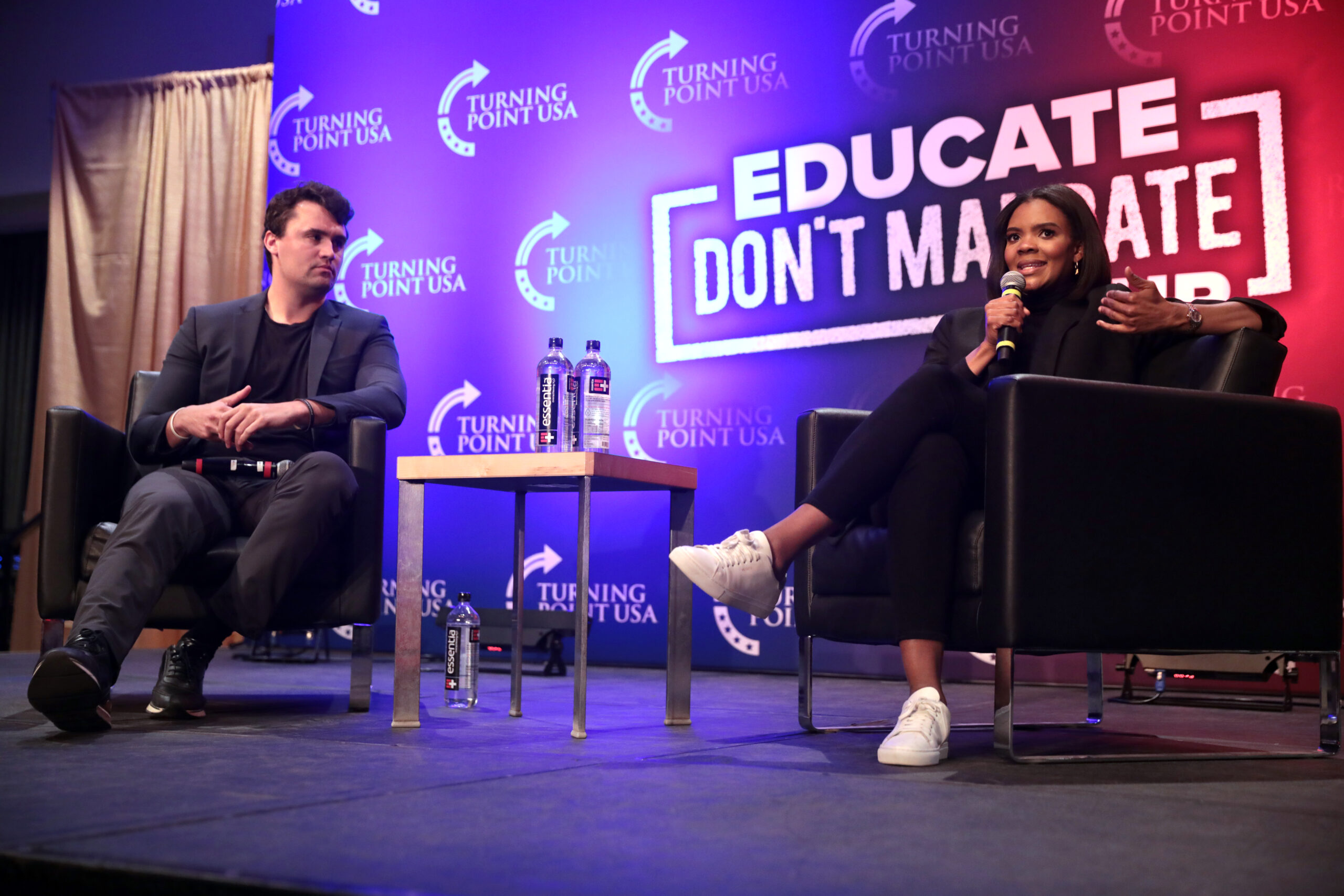
Candace Owens has turned a private legal warning into her latest public brawl, blasting Erika Kirk and Turning Point USA after receiving a cease-and-desist over her relentless commentary on Charlie Kirk’s assassination. What started as a supposed truce between the conservative podcaster and the late activist’s widow has now morphed into a messy, highly personal feud, complete with assassination conspiracies, leaked messages, and accusations of betrayal inside the right’s own media ecosystem. As Owens doubles down on her theories and legal threats pile up, the fight is exposing deep fractures in a movement that once rallied around the same star.
The clash is not just about one letter or one podcast episode, it is about who gets to define the story of Charlie Kirk’s life and death, and what counts as “truth” in an era when conspiracy content can be monetized in real time. With Erika Kirk trying to protect her husband’s legacy and Turning Point USA trying to shield its brand, Owens is positioning herself as the unfiltered investigator who refuses to back down, even as critics say she is exploiting a tragedy.
The assassination that shattered a movement
Before the legal threats and podcast wars, there was the killing that shook the conservative world. Charlie Kirk, the founder of Turning Point USA, was assassinated on September 10, 2025, while speaking at Utah Valley University in Orem, Utah, an event that ended with him throwing hats to the crowd just moments before the attack. According to the official account, Kirk was shot inside a tent at the venue and the suspected gunman later surrendered to the local sheriff, a sequence of events that quickly turned the “Assassination of Charlie Kirk” into a national trauma for his supporters and a flashpoint for political anger across the country, as detailed in the formal record of the Assassination of Charlie.
The shock waves went far beyond the campus in Orem, Utah, where Kirk’s final appearance was captured in photos by Trent Nelson and others as he worked the crowd at Utah Valley University. In the months that followed, the killing of the high profile activist and Turning Point USA founder became a cultural and political touchstone, sparking everything from disciplinary cases against professors who posted vulgar reactions to his death to a broader debate over how far political rhetoric had spiraled. Coverage of the fallout, including the way universities handled those professors disciplined for their posts, underscored how Kirk’s assassination instantly became more than a crime scene, it became a litmus test for the culture war he had helped fuel.
Candace Owens turns skeptic-in-chief
Into that raw space stepped Candace Owens, a conservative commentator who has built a brand on saying the quiet part out loud and then doubling down when critics push back. Rather than accept the FBI’s version of events, Owens quickly cast herself as an independent investigator, telling a story that, in her own framing, ran “very contrary” to what federal agents had laid out. She questioned nearly every part of the official narrative, from the photos of the tent where Kirk was killed to the timeline of the shooter’s surrender, arguing that the government’s account was being cemented in the public eye before basic questions had been answered, a posture captured in reporting on how Owens tells a that diverges sharply from the FBI.
Owens’s skepticism did not emerge in a vacuum. She was already a prominent figure in conservative media, with a large following that treats her commentary as a mix of political analysis and cultural provocation, and her profile as Candace Owens meant that any alternative narrative she floated about Kirk’s death would instantly reach millions. By framing herself as the one willing to ask “forbidden” questions about the FBI and the investigation, she set the stage for a months long campaign of videos, posts, and live streams that treated the assassination less as a closed case and more as an unsolved mystery begging for a crowd sourced reexamination.
From betrayal claims to “time traveler” theories
As the months went on, Owens’s commentary moved from procedural doubts into outright conspiracy territory. She began suggesting that Charlie Kirk had been betrayed by people in his inner circle and hinted at a multinational plot behind the killing, telling her audience that powerful forces had reasons to want him silenced. In one widely discussed stretch of coverage, she claimed that Kirk had been “marked” as a young child and that his path into politics was not accidental, a framing that fed into her broader narrative that his assassination was not just a lone gunman but part of something much larger, a storyline that was summarized in accounts of what Owens has about betrayal and conspiracy.
Then came the twist that pushed her into full viral territory: the “time traveler” claim. In a recent episode, Owens told listeners that Kirk was a time traveler targeted by powerful forces, tying his life and death to the CIA’s “Project Looking Glass” and to the internet’s favorite glitch-in-reality trope, the Mandela Effect. She suggested that Kirk had been drugged and manipulated, and that his assassination was linked to secret programs that let elites see or alter timelines, a theory that drew intense backlash and disbelief across social media as people reacted to her time travel claim. Coverage of her remarks noted that she explicitly invoked the CIA and “Project Looking Glass,” and that she folded Mandela Effect lore into her argument, a mix that was further detailed in reports on how Owens’s claims touched on those fringe theories.
Erika Kirk steps in and a “summit” is set
For Erika Kirk, the widow of the slain activist, Owens’s escalating theories were not just abstract content, they were personal. As the person closest to Charlie Kirk, and as a public figure in her own right within conservative circles, Erika Kirk found herself watching a high profile commentator turn her husband’s death into a serialized mystery show. Eventually she decided to engage directly, agreeing to meet with Owens in what both sides framed as a private conversation meant to clear the air and, at least in theory, cool down the conspiracy chatter around the founder of Turning Point USA.
The two women eventually held what was widely described as a “summit,” a long, private meeting that Owens later said lasted roughly four and a half hours. In her first podcast episode after that conversation, she recounted the exchange in detail, telling listeners that she and “Erica Kirk” had gone back and forth over what should be shared publicly and what should remain private, a retelling that was captured in a video of that first podcast episode. Reporting on the meeting noted that Erika Kirk had initially hoped for a more discreet, off camera reset, but that expectation collided with Owens’s instinct to turn every major moment into content, a dynamic summed up in analysis that observed that if Kirk hoped for solemnity from Owens, that mission clearly failed and that this kind of blow up is very much Candace Owens specialty.
The cease-and-desist lands
Whatever goodwill the “summit” generated did not last long. Within weeks, Owens told her audience that she had received a legal cease-and-desist letter from Turning Point USA, the organization Charlie Kirk founded and the group that still carries his name. She said the letter ordered her to stop blaming the group for Kirk’s murder and to pull back on her public accusations, a move that was described as Turning Point USA to shut down her commentary. Owens, for her part, framed the letter as proof that she was over the target, telling followers that the group was trying to silence her instead of answering questions about security, internal conflicts, and the handling of threats before the assassination.
Owens did not keep the legal warning behind the scenes. She shared details of the cease-and-desist on her social media, including on Insta, and described it as part of a broader “lawsuit era” in which organizations try to manage reputational damage through aggressive legal tactics. Coverage of the dispute noted that TPUSA’s letter focused on her coverage of Charlie Kirk’s death and that she had run her commentary in parallel with the official investigation, a strategy that was unpacked in reporting on how TPUSA has sent that letter. Another account emphasized that the cease-and-desist arrived after an apparent truce with Erika Kirk and that Owens herself described it as a “legal letter” sent by Turning Point USA, a sequence detailed in coverage of how the Conservative podcaster Candace TPUSA had moved against her.
Owens hits back at Erika Kirk and TPUSA
Instead of backing off, Owens treated the cease-and-desist as fresh fuel. She publicly mocked the letter, telling followers that she would respond with sarcasm rather than compliance and casting herself as the target of a coordinated attempt to muzzle uncomfortable questions. On social media, she said that Turning Point USA had sent her a legal warning to stop her from criticizing the organization and from connecting it to Kirk’s murder, a framing that was echoed in posts describing how Conservative commentator Candace she received that cease-and-desist. She also made clear that she saw the letter as a political move, not just a legal one, telling her audience that powerful institutions were trying to scare people away from asking who might have benefited from Kirk’s death.
Owens’s criticism did not spare Erika Kirk. In her telling, the widow had tried to rein her in during their long meeting, urging more discretion and less speculation, only to then stand by while TPUSA’s lawyers came after her. That perceived double cross became part of Owens’s narrative, as she suggested that Erika Kirk’s leadership inside the movement was failing and that she was more focused on brand management than on transparency. Coverage of the feud noted that Owens shared alleged threatening messages that had been sent to Charlie Kirk and used them to question Erika Kirk’s leadership and motives, a move described in reports on how Candace Owens shares and uses them to question Erika Kirk’s methods.
The legal fight goes live
As the dispute escalated, it did not stay confined to written statements and Instagram stories. The legal drama itself became content, with live streams and commentary shows dissecting the cease-and-desist and speculating about what might come next. One widely shared broadcast framed the situation as “Candace Owens in LEGAL Trouble” and walked viewers through the letter from Charlie Kirk’s TPUSA, treating the document as both a legal threat and a political statement about who controls the narrative around the assassination, a framing captured in a LIVE video that turned the conflict into appointment viewing.
Owens herself leaned into that spectacle. She told her audience that “Turning Point USA sent me a legal letter” and cast the move as part of a broader trend in which lawsuits and cease-and-desists are used to police speech inside the conservative movement. Reporting on the conflict noted that the letter came after an apparent truce with Erika Kirk and that it specifically targeted Owens’s attempts to link TPUSA and a man named Tyler Robinson to Kirk’s murder, details that were laid out in coverage of how the cease-and-desist letter has the conflict. Another account emphasized that Owens shared the letter online, where it was quickly circulated, and that she described the current moment as a “lawsuit era,” a phrase that appeared in reporting on how the letter was received with sarcasm rather than compliance.
More from Vinyl and Velvet:

Leave a Reply