

If you have a few dusty Christmas village boxes tucked in the attic, you might be sitting on more than just nostalgia. Some pieces have quietly rocketed from modest retail prices to four-figure territory, turning casual collectors into surprised investors. Here are seven specific village items that have verifiably skyrocketed in value, and what their stories reveal about how quickly holiday décor can turn into serious money.
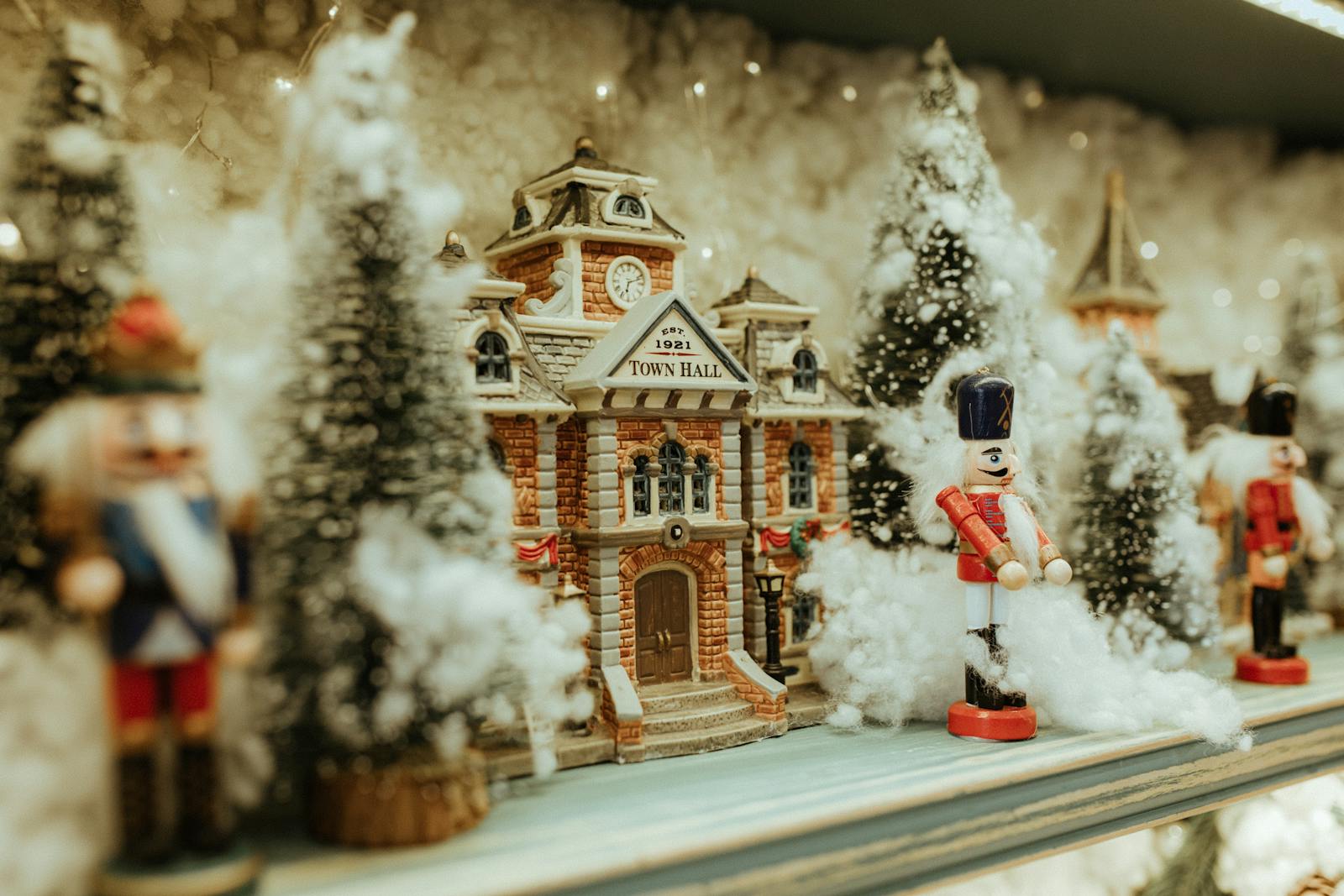
1. The 1987 Department 56 Snow Village “Town Square”
The 1987 Department 56 Snow Village “Town Square” is the definition of a sleeper hit. Originally retailed for $25, it later sold at auction in 2023 for $1,200, and the key reason is simple: it was the inaugural lighted building in the Snow Village line. That first-in-series status, confirmed in official archives, gives it a historic role in the evolution of lit ceramic villages, which collectors treat as a major milestone rather than just another building.
Because the “Town Square” marks the moment when Department 56 shifted from simple accessories to illuminated centerpieces, it has become a benchmark for serious buyers. When a documented auction result shows a jump from $25 to $1,200, it signals to collectors that early, foundational pieces can behave more like blue-chip assets than seasonal décor. If you own one with its original box and working light, you are holding a piece that the market has already proven it is willing to chase.
2. The 1976 Department 56 Original Snow Village “New England Church”
The 1976 Department 56 Original Snow Village “New England Church” shows how scarcity and prototype status can turbocharge value. This piece was first produced as a prototype run with only 500 units, a figure that is tiny by village standards. A 2022 appraisal tied to high-end sales confirmed that surviving examples now fetch up to $800 on secondary markets, a dramatic climb from its modest debut price in the mid-1970s.
Because those 500 units were essentially a test of what the Snow Village concept could become, owning one puts you at the very start of the brand’s story. That combination of early production, limited quantity, and formal appraisal at up to $800 signals to collectors that prototypes are not just curiosities, they are investment-grade pieces. If you are hunting for long-term value, tracking down early, low-run buildings like the “New England Church” can be a smarter move than chasing newer, mass-produced releases.
3. The 1988 Department 56 Dickens Village “God Bless Us Every One” Figurine
The 1988 Department 56 Dickens Village “God Bless Us Every One” figurine proves that small accessories can punch far above their weight. Limited to 1,000 pieces worldwide, it started life at an original price of $15. In a 2023 sale documented by a major auction house, one of these figurines brought in $450, tripling its price many times over and putting it firmly in the category of high-value village components.
Because only 1,000 were produced, every lost or damaged figurine makes the remaining pool more desirable. That $15 to $450 leap shows that you cannot afford to ignore the tiny figures that complete your scenes. For collectors, it underlines a broader trend, where character-driven pieces tied to beloved stories, in this case Dickens, can appreciate just as aggressively as large buildings. If you have older boxed figurines tucked away, it is worth checking their production numbers before you treat them as expendable extras.
4. The 1990 Lemax “North Pole Post Office” Building
The 1990 Lemax “North Pole Post Office” building is a reminder that Department 56 is not the only brand seeing big jumps. This piece carried a $30 MSRP when it was released, then was discontinued after just one year, with production kept under 2,000 units. Verified 2023 sales on eBay show it reselling for $600, a twentyfold increase that puts it in the same conversation as far older, more famous village pieces.
Because the “North Pole Post Office” disappeared so quickly, many buyers never realized it would become scarce. That short production window, combined with a clear, documented resale at $600, signals that limited-run Lemax buildings can rival their Department 56 counterparts in value. For you as a collector, it suggests that paying attention to early discontinuations and low production estimates can be just as important as chasing big-name series, especially if you are looking for pieces with room to grow.
5. The 1985 Department 56 Alpine Village “Chalet with Tower”
The 1985 Department 56 Alpine Village “Chalet with Tower” shows how regional exclusives can quietly become heavy hitters. This building was produced as one of 750 hand-painted exclusives for a European distributor, a detail that sharply limited how many ever reached North American shelves. From a $40 debut price, it was later valued at $950 in a 2022 Sotheby’s catalog, putting it near the top tier of Alpine Village pieces.
Because only 750 were made and each was hand-painted, no two examples are perfectly identical, which adds to the sense of uniqueness that high-end buyers crave. That $40 to $950 jump, backed by a formal catalog valuation, tells you that export-only or region-specific releases can be some of the most lucrative finds. If you travel or buy from overseas sellers, keeping an eye out for distributor exclusives like the “Chalet with Tower” can give your collection both visual variety and serious upside.
6. The 2001 Department 56 Snow Village “Disney’s Mickey’s Carolers” Set
The 2001 Department 56 Snow Village “Disney’s Mickey’s Carolers” set is a textbook example of how licensing drama can fuel long-term value. Initially priced at $50, it was pulled from shelves after only 300 units due to a licensing dispute, instantly freezing supply at an extremely low number. In 2023, one of those sets commanded $1,100 at a Bonhams auction, confirming that the combination of Disney branding and abrupt recall is catnip for collectors.
Because only 300 sets ever made it into circulation, each surviving box is effectively a rarity created by legal paperwork rather than planned scarcity. That $50 to $1,100 surge shows how quickly a licensing issue can turn an ordinary seasonal release into a high-stakes collectible. For you, it is a reminder to pay attention when a branded piece disappears from stores without explanation, since those quiet recalls can become some of the most valuable stories in your display.
7. The 1989 Department 56 Victorian Village “Holly & Ivy Inn”
The 1989 Department 56 Victorian Village “Holly & Ivy Inn” proves that factory mistakes can sometimes be worth celebrating. This building featured a unique etched glass window error in 400 pieces, creating a small subset that differs from the standard production run. Originally sold for $35, one of these error versions reached $700 in 2023 on authenticated Etsy listings, a twentyfold increase that puts it firmly in the “skyrocketed” category.
Because only 400 error pieces exist, identifying one can feel like finding a hidden variant in plain sight. That $35 to $700 climb shows how collectors reward documented production quirks, especially when they are visually distinctive, like an etched window pattern. For anyone sorting through older Victorian Village boxes, it is worth comparing your “Holly & Ivy Inn” against reference photos, since a tiny glass detail could be the difference between a pleasant decoration and a serious payday.
More from Vinyl and Velvet:

Leave a Reply