

Movie lines have a way of slipping into everyday speech, and for the boomer generation, some of the most quoted phrases come straight from mid‑century and late‑twentieth‑century cinema. Many boomers use these lines so often that the original scenes have faded, even as the dialogue still shapes how they joke, argue, and say goodbye. Here are 11 movie quotes that boomers still drop into conversation without always realizing they are quoting the big screen.
1) “Frankly, my dear, I don’t give a damn” from Gone with the Wind (1939)
“Frankly, my dear, I don’t give a damn” is the parting shot Clark Gable delivers as Rhett Butler to Vivien Leigh’s Scarlett O’Hara in the closing scene of Gone with the Wind. A Wikipedia entry on the line notes how “Frankly” from “Gone With The Wind” starring Clark Gable and Vivien Leigh became one of cinema’s most famous send‑offs, while separate coverage of Butler’s last line in “Gone With the Wind” highlights how the word “damn” pushed against the Hays Code. Yet boomers often repeat it as a casual, even playful, dismissal in family spats or office disagreements.
By the 1940s and 1950s, the phrase had already seeped into common parlance, so younger boomers heard parents and teachers quote it long before they saw the film. Mental Floss reporting describes how many boomers now use it as a stock retort in arguments, rarely pausing to recall the censorship battle that once made the word “damn” controversial. The stakes are cultural memory: a line that once signaled Hollywood’s willingness to test moral boundaries now survives mostly as a shorthand for “I am done with this conversation.”
2) “Here’s looking at you, kid” from Casablanca (1942)
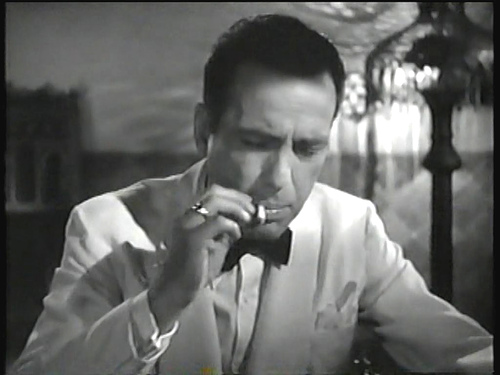
“Here’s looking at you, kid” is Humphrey Bogart’s bittersweet toast as Rick Blaine to Ingrid Bergman’s Ilsa Lund at Rick’s Café Américain in Casablanca. Reader’s Digest reporting explains that Bogart developed the line during real‑life poker games with Bergman, then folded it into their on‑screen chemistry. By the 1960s and 1970s, boomers were clinking highball glasses at house parties and campus gatherings, repeating the phrase as a knowing, slightly romantic salute.
The quote’s endurance among boomers reflects how black‑and‑white classics remained television staples well into their youth. Saying “Here’s looking at you, kid” at a barbecue or retirement dinner lets them borrow Bogart’s cool while softening the moment with nostalgia. It also shows how a line born from off‑camera banter can become a generational catchphrase, turning private poker‑table improvisation into public social glue.
3) “Toto, I’ve got a feeling we’re not in Kansas anymore” from The Wizard of Oz (1939)
“Toto, I’ve got a feeling we’re not in Kansas anymore” is Judy Garland’s wide‑eyed reaction as Dorothy Gale when her house lands in Munchkinland’s Technicolor world. BBC Culture’s analysis notes that the line has roots in L. Frank Baum’s 1900 novel but became iconic through the film’s sudden shift into color, which etched Dorothy’s disorientation into viewers’ minds. By the 1970s, boomers were using it as a go‑to metaphor for culture shock, from first trips abroad to walking into a radically modern office.
The phrase now surfaces whenever surroundings feel unfamiliar, whether a boomer is navigating a new smartphone interface or visiting a grandchild’s dorm. Its popularity underscores how The Wizard of Oz taught generations to frame change as both unsettling and magical. When boomers say it, they are not just quoting a movie; they are signaling that they recognize the ground has shifted and that everyone in the room is sharing a moment of collective “where are we?” bewilderment.
4) “There’s no place like home” from The Wizard of Oz (1939)
“There’s no place like home” is the mantra Judy Garland’s Dorothy chants while clicking her ruby slippers three times in Emerald City, hoping to return to Kansas. A Smithsonian history of American icons points out that the ruby slippers from The Wizard of Oz are preserved alongside the message “There’s no place like home,” underscoring how deeply the line is woven into U.S. culture. Mental Floss notes that for boomers, the phrase became a nostalgic sigh at family gatherings, especially around holidays.
Regular television broadcasts of The Wizard of Oz in the 1950s meant many boomers first heard the line curled up on living‑room sofas, often with parents or grandparents nearby. Saying it today at the end of a long trip or after a stressful workday taps into that childhood comfort. The phrase also shapes how boomers talk about aging in place, reinforcing the idea that home, however modest, is the ultimate refuge from a chaotic world.
5) “May the Force be with you” from Star Wars (1977)
“May the Force be with you” is Alec Guinness’s calm blessing as Obi‑Wan Kenobi to Mark Hamill’s Luke Skywalker before they enter the Death Star in Star Wars. Mental Floss reporting ties the line to the film’s opening crawl and notes that the movie’s cultural phenomenon helped it gross 775,000,000 dollars worldwide. As the franchise exploded, boomers who were then young adults began using the phrase as a lighthearted farewell in 1980s offices, especially in tech and engineering circles.
In practice, the line functions like a secular “good luck,” acknowledging unseen challenges ahead. When a manager tells a colleague “May the Force be with you” before a tough presentation, they are importing the film’s mythic language into everyday corporate stakes. The quote’s persistence shows how science‑fiction spirituality gave boomers a shared vocabulary for resilience, one that still surfaces in email sign‑offs and retirement speeches.
6) “I’ll make him an offer he can’t refuse” from The Godfather (1972)
“I’ll make him an offer he can’t refuse” is Marlon Brando’s silky threat as Vito Corleone to Al Pacino’s Michael Corleone during Connie Corleone’s wedding in The Godfather. Reader’s Digest coverage links the line directly to the novel’s infamous horse‑head intimidation tactic, where a studio executive wakes to find a prized animal in his bed. BBC Culture’s 2023 feature traces how boomers carried the phrase into 1980s business negotiations, using it jokingly to describe irresistible deals.
In boardrooms and sales calls, boomers often deploy the line with a chuckle, signaling toughness without actual menace. Yet its popularity also hints at how mob‑movie ethics seeped into corporate metaphors, framing hard bargaining as a kind of cinematic power play. When a senior partner promises an “offer he can’t refuse,” the stakes are reputational as much as financial, since the speaker is aligning themselves with Vito Corleone’s aura of control.
7) “You can’t handle the truth!” from A Few Good Men (1992)
“You can’t handle the truth!” erupts from Jack Nicholson’s Col. Nathan Jessup as he is cross‑examined by Tom Cruise’s Lt. Daniel Kaffee in the climactic courtroom scene of A Few Good Men. BBC Culture notes that although the film arrived after the boomer youth years, its life on VHS and cable made the line a staple of 1990s living rooms. Mental Floss adds that boomers quickly adopted it as a defensive retort in heated debates about politics, parenting, or office policy.
Used in conversation, the quote flips the burden of proof, suggesting that the listener’s fragility, not the speaker’s argument, is the problem. That rhetorical move has real stakes in family and workplace conflicts, where invoking Jessup’s line can shut down discussion rather than invite nuance. Its endurance shows how courtroom dramas taught boomers to frame disagreements as battles over who can “handle” reality, not just who has better evidence.
8) “Show me the money!” from Jerry Maguire (1996)
“Show me the money!” is Cuba Gooding Jr.’s exuberant demand as Rod Tidwell to Tom Cruise’s Jerry Maguire during a frantic phone negotiation over a 25,000,000 dollar contract. Mental Floss traces how the scene, with Tidwell forcing Maguire to shout the phrase louder and louder, became a rallying cry for late‑1990s sales teams. Reader’s Digest reporting notes that boomers in real estate, insurance, and advertising quickly folded it into pep talks and client banter.
In practice, the line lets boomers acknowledge the blunt reality of capitalism while keeping things playful. A manager yelling “Show me the money!” across a cubicle farm turns revenue targets into a shared joke, even as the pressure to hit numbers remains intense. The quote’s staying power reflects a broader trend in which sports‑agent drama gave boomers a language for commission culture, celebrating hustle while quietly normalizing relentless financial focus.
9) “Life is like a box of chocolates. You never know what you’re gonna get” from Forrest Gump (1994)
“Life is like a box of chocolates. You never know what you’re gonna get” is narrated by Tom Hanks as Forrest Gump to Robin Wright’s Jenny Curran while they sit on a bench in Savannah, Georgia. Reader’s Digest points out that the line, adapted from Winston Groom’s 1986 novel, became iconic through the film’s Alabama bus stop framing, where strangers cycle in and out as Forrest reflects on his past. BBC Culture notes that boomers embraced it as a go‑to platitude for uncertainty during 2000s retirement talks.
When boomers quote the line at financial‑planning meetings or over coffee with friends, they are acknowledging that markets, health, and family paths are unpredictable. The phrase softens anxiety by wrapping it in folksy wisdom, suggesting that surprises are baked into the deal. Its popularity also shows how a single metaphor can bridge generations, giving grandparents and grandchildren a shared way to talk about risk and fate.
10) “E.T. phone home” from E.T. the Extra-Terrestrial (1982)
“E.T. phone home” is whispered by the alien E.T., voiced by Pat Welsh, to Henry Thomas’s Elliott in a suburban California bedroom as they rig a Speak & Spell device to contact his planet. BBC Culture’s account ties the line to the film’s 435,000,000 dollar box office and its famous Reese’s Pieces product placement, which helped cement the story in popular memory. Mental Floss notes that by the 1990s, boomers were using the phrase as a lighthearted way to say they needed help or wanted to check in with family.
In everyday speech, “E.T. phone home” can mean anything from “call me when you get there” to “I need backup on this project.” The quote captures a mix of vulnerability and resourcefulness, echoing the film’s theme of a stranded outsider relying on friendship and ingenuity. Its continued use among boomers highlights how early 1980s blockbusters shaped their language for technology, turning a child’s toy and a homesick alien into shorthand for connection.
11) “Hasta la vista, baby” from Terminator 2: Judgment Day (1991)
“Hasta la vista, baby” is Arnold Schwarzenegger’s deadpan send‑off as the T‑800 to Edward Furlong’s John Connor before blasting the liquid‑metal T‑1000 in the steel mill finale of Terminator 2: Judgment Day. Mental Floss notes that the Spanish phrase was improvised into the character’s limited vocabulary, giving the cyborg an unexpectedly cheeky personality. Reader’s Digest reporting adds that boomers quickly adopted it as a swaggering goodbye in 1990s action‑movie contexts, from gym exits to office happy hours.
The line’s mix of faux‑toughness and humor made it ideal for a generation that grew up on Westerns and war films, then embraced high‑octane science fiction. Saying “Hasta la vista, baby” lets boomers play at being indestructible while actually signaling affection or camaraderie. Its influence even reaches film criticism, where writers such as Mark Cousins, in The Story of Film, and essays on Judy Garland and The Wizard of Oz trace how catchphrases like this reshape English, proving that boomer movie quotes still echo far beyond the multiplex.
More from Vinyl and Velvet:

Leave a Reply