

The toys that defined the 1960s did more than fill playrooms, they mirrored a decade of cultural upheaval, television obsession, and space-age imagination. As you look back on these 10 classics, you can see how they sat alongside psychedelic rock, black-and-white TV hits, and big-screen epics to shape what childhood felt like in that era.
1) Etch A Sketch
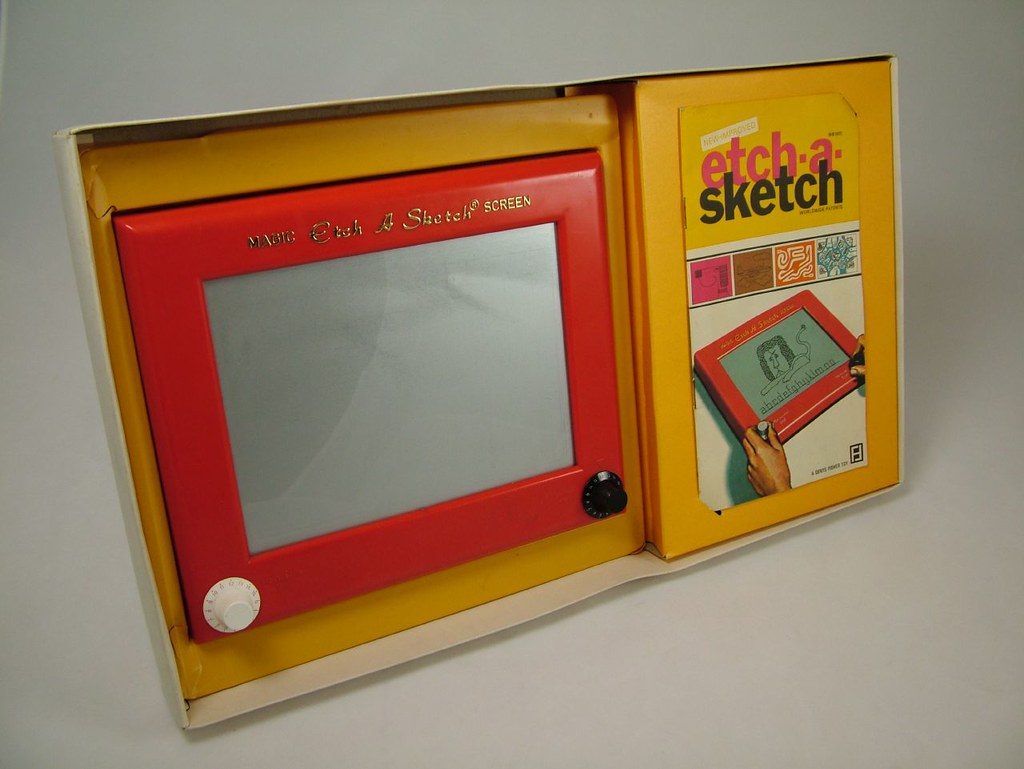
Etch A Sketch captured the inventive drawing fun that made it a must-have for kids who wanted to sketch, erase, and start again with a simple twist of two knobs. It appears among the popular toys every kid in the ’60s could not wait to get, confirming how central it was to the decade’s playrooms. Later coverage of how the Etch A Sketch etched itself into pop culture notes that for To Davis, the toy is a canvas, and he spends about 15 to 30 minutes on each drawing, underscoring how seriously some fans still treat this “classic toy from their childhood.”
That mix of casual fun and surprising artistic depth helped Etch A Sketch fit right in with a culture that was also experimenting visually, from bold poster art to the swirling imagery of psychedelic rock songs. For you, the stakes of this little red frame were big, it offered a rare sense of control in a fast-changing world, letting you literally redraw your own lines whenever you wanted.
2) G.I. Joe
G.I. Joe revolutionized action figures by presenting a fully articulated soldier that kids could pose, outfit, and send into elaborate missions. It is listed among the popular toys every kid in the ’60s wanted, highlighting how quickly it became a fixture in bedrooms and backyards. Instead of a simple plastic figurine, you got a figure with uniforms, gear, and vehicles that invited long-running storylines, often inspired by the war movies and adventure serials that dominated afternoon television.
The broader culture of the 1960s, from gritty war dramas to the sprawling epics highlighted in great movies of the 1960s, gave G.I. Joe a ready-made narrative backdrop. For parents and kids, the toy reflected real-world tensions while turning them into manageable, imaginative play, a way to process headlines through missions, rescues, and battles staged on the living-room floor.
3) Easy-Bake Oven
Easy-Bake Oven brought mini baking excitement into the home, letting you slide tiny pans into a glowing chamber and pull out real, if small, cakes and cookies. It appears as one of the popular toys every kid in the ’60s craved, a sign that pretend play was shifting toward more realistic, hands-on experiences. The appeal was simple, you were not just playing house, you were actually cooking, using mixes and recipes that felt grown-up even if the portions were bite-sized.
That realism mattered in a decade when television cooking shows and glossy food advertising were reshaping how families thought about meals. Easy-Bake Oven gave children, especially girls who were often targeted in the marketing, a sense of agency in the kitchen. At the same time, it hinted at broader changes in gender roles, as more kids of all backgrounds experimented with baking and shared the results at parties and holiday gatherings.
4) Spirograph
Spirograph enabled hypnotic geometric art creation, turning simple plastic gears and pens into intricate spirals that felt almost mathematical. It is singled out as a classic toy from the 1960s in a video that urges you to “grab your Spirograph, get creative, and let your imagination run wild,” describing it as a Classic toy that is still around. Its inclusion among the popular toys every kid in the ’60s wanted reflects how strongly those swirling designs stuck in people’s memories.
In a decade obsessed with bold graphics, from concert posters to animated title sequences on unforgettable black-and-white shows, Spirograph gave you a way to produce your own eye-catching patterns. The toy quietly encouraged an interest in design and geometry, showing that creativity and precision could go hand in hand, and it still resonates today with anyone who remembers filling notebook pages with looping, colorful shapes.
5) Twister
Twister turned physical play into a party game staple, spreading a plastic mat on the floor and challenging you to place hands and feet on colored circles without falling. It is counted among the popular toys every kid in the ’60s could not wait to try, and its appeal was obvious, it broke the boundary between board game and full-body activity. Instead of sitting around a table, you were laughing, stretching, and toppling over friends and siblings.
The game’s slightly chaotic, sometimes silly physical contact fit neatly into a youth culture that was already pushing social boundaries on dance floors and at concerts. Twister also became a television-friendly spectacle, easy to feature on variety shows that were as central to the decade as the era’s music. For families, it offered a low-tech way to bring that same energy into the living room, turning any gathering into an instant event.
6) Operation
Operation delivered a thrilling, buzzer-backed version of surgical simulation, asking you to remove tiny plastic ailments from a cartoon patient without touching the metal edges. It is firmly placed among the popular toys every kid in the ’60s chased, because the tension of that sudden buzz and flashing nose was unforgettable. The game rewarded steady hands and concentration, but it also invited plenty of laughter when someone slipped and set off the alarm.
In a decade when medical dramas and hospital scenes were common on television, Operation gave you a playful way to step into that world. The stakes felt high in the moment, even if the “patient” was just a cardboard cutout, and the game subtly introduced ideas about anatomy and precision. It also showed how electronics were creeping into toys, foreshadowing the more complex interactive games that would follow in later decades.
7) Rock ‘Em Sock ‘Em Robots
Rock ‘Em Sock ‘Em Robots sparked battling robot mania, pitting two plastic fighters against each other in a ring where one good uppercut could pop a head up in defeat. The toy is highlighted in a video that invites you to Join Penn State Behrend for some history on Rock Em Sock Em Robots, underscoring its lasting cultural footprint. A 1964 commercial described them as “the world’s only boxing robots,” noting that it “Takes two managers to handle the action,” a line that still captures their competitive charm.
That head-to-head format echoed the era’s fascination with televised boxing matches and sci-fi robots, blending sports and futurism in a way kids instantly understood. Later, clips like Rock Sock Robots Family Fun Classic Game for Ryan and Ryan show how the toy still works as a simple, high-energy showdown. For you, the game distilled rivalry into bright plastic and rapid-fire button mashing, a template for countless versus-style games that followed.
8) Hot Wheels
Hot Wheels ignited speed and track-building obsessions, giving you die-cast cars that felt faster and flashier than anything that had come before. They are included among the popular toys every kid in the ’60s chased, a testament to how quickly those orange tracks and loop-the-loops took over playrooms. The cars’ bright paint jobs and stylized designs mirrored the muscle cars and concept vehicles that were turning heads on real highways.
As 1960s cinema filled screens with road movies and chase scenes, like those celebrated among great 60s movies, Hot Wheels let you stage your own stunts at home. The toy encouraged basic engineering instincts, you experimented with gravity, angles, and momentum to keep cars on the track. For many kids, it was an early lesson that design and performance could be tweaked, tested, and improved, one crash at a time.
9) Troll Dolls
Troll Dolls embodied quirky collectible charm, with wild hair and impish grins that made them instantly recognizable. They are featured among vintage toys worth money, with their 1960s popularity helping drive today’s collector interest. The figures’ simple shapes and bright colors made them easy to line up on shelves, trade with friends, or tuck into school bags as tiny good-luck charms.
In a decade when pop culture was embracing the offbeat, from novelty songs to eccentric TV characters, Troll Dolls fit right in. Their enduring value on the secondary market shows how strongly they are tied to childhood memories, especially for those who grew up alongside the era’s black-and-white shows and early color broadcasts. For you, owning a Troll Doll was less about gameplay and more about identity, a small, strange mascot that signaled your taste for the whimsical.
10) Chatty Cathy
Chatty Cathy defined talking doll innovation, giving children a toy that could “speak” when you pulled a string on her back. She appears among vintage toys worth money, with that 1960s fascination with voice technology helping drive her modern-day appeal. The doll’s recorded phrases made her feel more lifelike than earlier dolls, turning simple tea parties and pretend school sessions into conversations that seemed almost real.
Her popularity unfolded alongside the rise of character-driven television and family films, including holiday favorites cataloged among 1960s Christmas movies. Chatty Cathy showed how quickly kids embraced interactive features, even in analog form, and set expectations for future toys that would talk, sing, or respond. For parents and children alike, she marked a turning point, when dolls stopped being silent props and started to feel like companions with personalities of their own.

Leave a Reply