

Some paper bills in your wallet or family keepsake box are worth far more than their printed denomination. The right combination of artwork, rarity, and history can turn a simple note into a five‑, six‑, or even seven‑figure prize. If you spot any of the following notes, think twice before spending them, because collectors may pay life‑changing sums.
1) The 1896 $1 “Educational” Silver Certificate
The 1896 $1 “Educational” Silver Certificate is one of the most admired designs in U.S. currency, showing allegorical figures of History instructing Commerce across a sweeping vignette. In uncirculated condition, this note can fetch up to $5,000 or more at auction, according to PCGS CoinFacts, which is why you should never treat a crisp example as spending money. That value reflects both the artistry and the limited survival of high‑grade pieces.
Collectors often pursue the entire Educational series, including the famous PMG Gem Uncirculated 65 EPQ 1896 $2 Silver Certificate highlighted in a special catalog, so demand for the $1 note stays strong. For you, that means even a lightly circulated example can be a gateway into a high‑end market where eye appeal, originality, and historical themes command serious premiums.
2) The 1928A $1 Silver Certificate “Mule” Error Note
The 1928A $1 Silver Certificate “Mule” is a classic error note, pairing a 1928A face with a back from the 1923 series. This printing mismatch was only discovered in 1991, long after most had circulated unnoticed, which helps explain why a certified example sold for $16,100 in 2013 at Heritage Auctions. That price shows how a subtle production quirk can transform a common denomination into a serious collectible.
Because the error is buried in the design details, many surviving notes may still sit in collections or old envelopes, unrecognized by their owners. If you handle early small‑size Silver Certificates, checking for the 1923‑style back on a 1928A face could uncover a windfall. For collectors, this mule illustrates how careful study of series, plates, and backs can unlock value that casual observers never see.
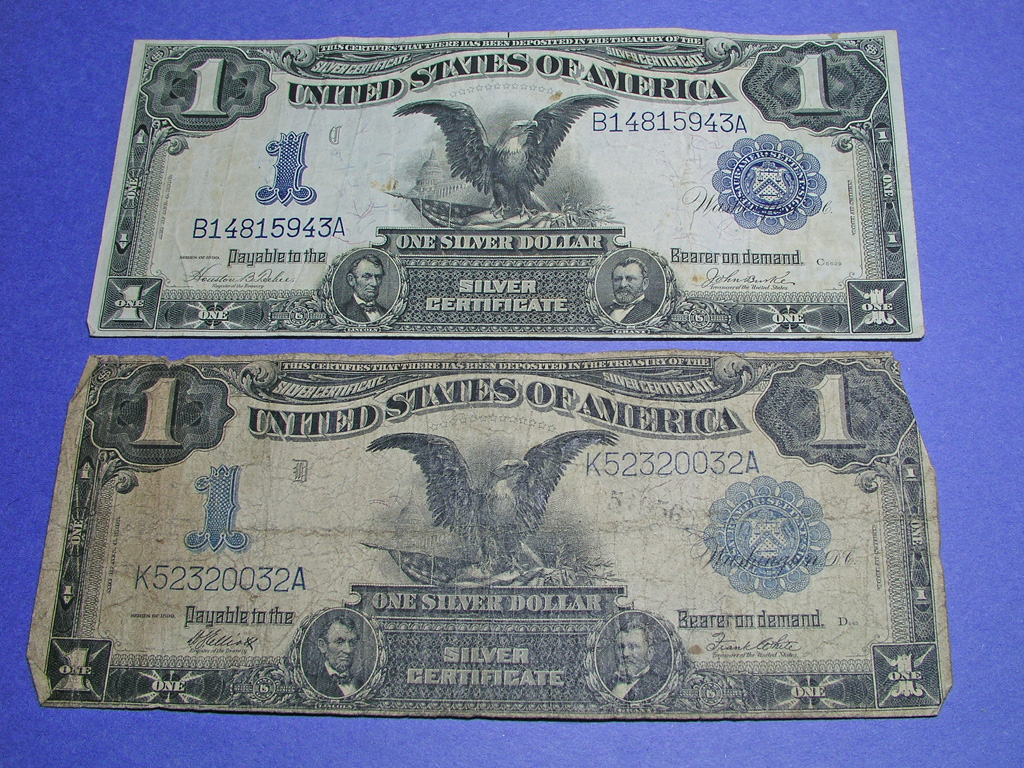
3) The 1899 $1 “Black Eagle” Silver Certificate
The 1899 $1 “Black Eagle” Silver Certificate is instantly recognizable, with a bold eagle spreading its wings over portraits of Abraham Lincoln and Ulysses S. Grant. While lower‑grade examples are relatively available, gem condition notes are a different story, reaching $10,000+ according to 2020 auction data from Stack’s Bowers. That gap between common and exceptional grades is why you should scrutinize any Black Eagle before assuming it is only worth a dollar.
The design’s patriotic imagery keeps demand high, especially among type collectors who want a single standout example of each major design. Centering, color, and paper originality separate a four‑figure note from a modest one, so professional grading often becomes essential. For you as a potential seller, understanding how condition drives value can prevent you from underselling a note that looks ordinary but meets strict gem standards.
4) The 1869 $1 Legal Tender “Rainbow” Note
The 1869 $1 Legal Tender “Rainbow” Note stands out for its vivid inks, multicolored seals, and the portrait of Salmon P. Chase. The Red Book values this note at $4,000 in very fine condition, a figure that reflects both its age and its eye‑catching palette, which gives the series its “Rainbow” nickname. With that kind of pricing, spending one at face value would be a costly mistake.
Because these notes circulated heavily in the nineteenth century, many survivors are heavily worn, stained, or damaged. A solid very fine example with strong colors and minimal repairs sits in a sweet spot where collectors balance affordability and rarity. For you, recognizing the Rainbow’s distinctive hues and Chase’s portrait can help you quickly separate a major prize from more ordinary nineteenth‑century issues.
5) The 1918 $1 Federal Reserve “Airplane Vignette” Note
The 1918 $1 Federal Reserve Note with the “Airplane Vignette” back is a standout from the World War I era, featuring a rare aviation‑themed scene. Printed only briefly during WWI, this design did not last long in circulation, which is why a high‑grade example auctioned for $25,000 according to PMG notes. That result underscores how short production runs and distinctive artwork can combine to create intense collector interest.
Early aviation imagery appeals not only to currency specialists but also to enthusiasts of flight history, broadening the buyer base. As a result, top‑tier notes with sharp detail and original paper can spark bidding battles. If you encounter a 1918 $1 with an airplane scene on the back, treating it as a simple relic of WWI finance could mean overlooking a five‑figure asset.
6) The 1933 $10 Gold Certificate
The 1933 $10 Gold Certificate is one of the most coveted U.S. paper money rarities, a direct product of the Gold Reserve Act that pulled gold‑backed notes from circulation. Only 11 examples are known, and they are valued at over $1 million, as authenticated by the Smithsonian. With that level of scarcity and institutional recognition, this is a note you will never want to spend if you are fortunate enough to see one.
Because of legal restrictions and the tiny population, most surviving pieces reside in museums or tightly held private collections. The note’s story, tied to the end of circulating gold certificates, makes it a touchstone for understanding how U.S. monetary policy shifted in the 1930s. For you, the key takeaway is that any 1933‑dated gold certificate deserves immediate expert review, since even a single discovery could reshape the market.
7) The 1890 $20 “Grand Watermelon” Treasury Note
The 1890 $20 Treasury Note known as the “Grand Watermelon” is famous for the large, green, watermelon‑like zeros on its back. One of these notes sold for $30,000 in 2018 at Heritage Auctions, a figure that still pales beside the $1,000 1890 T.N. Grand Watermelon Sold for $1,092,500 reported in specialist journals. Those records show how the Grand Watermelon design, across denominations, can command extraordinary prices.
Further coverage of the $1,000 1890 T.N. Grand Watermelon Sold for $1,092,500, alongside Fr. 183c $500 notes, appears in another detailed account that begins, “When I find that note, I will tell you the long story of obtaining this great note,” as seen in subsequent reporting. For you, the lesson is clear, any Grand Watermelon, whether $20, $500, or $1,000, belongs in a high‑end auction, not in everyday commerce.
8) The 1923 $1 “Horseblanket” Gold Certificate
The 1923 $1 Gold Certificate, nicknamed the “Horseblanket,” is prized for its large size and intricate border patterns that predate today’s smaller notes. In choice condition, this issue is worth $15,000 according to the PCGS population report, a sharp contrast to its modest face value. That premium reflects both the note’s visual impact and the limited number of high‑grade survivors.
Collectors often seek these large‑size gold certificates to anchor a type set, since they represent the era when paper money explicitly promised payment in gold. For you, the oversized dimensions are an immediate clue that a note might be special. A well‑preserved Horseblanket with strong color and minimal folds should go straight to a specialist dealer or auction house rather than a cash register.
9) The 1953 $2 Red Seal Legal Tender Note
The 1953 $2 Legal Tender Note with a red seal might seem modern compared with nineteenth‑century rarities, but serial numbers can change everything. A note from this series with the ultra‑low serial number 00000001, graded gem, fetched $18,400 at auction in 2022, according to Stack’s Bowers. That result shows how even a relatively common design can become a major prize when paired with a standout serial.
Collectors pay premiums for “fancy” numbers, including ladders, repeaters, and especially the first note off the press. In the case of the 1953 $2 red seal, the combination of a popular type and the 00000001 serial created intense competition. For you, it is a reminder to inspect serial numbers carefully, since a seemingly ordinary bill from the 1950s could be worth more than a used car if the digits line up just right.
10) The 1875 $5 National Bank Note from New York
The 1875 $5 National Bank Note from a charter like The First National Bank of New York represents an era when local banks issued federally backed currency. In high grade, such a note is valued at $50,000+, as reported in the Comprehensive Catalog of U.S. Paper Money, reflecting both its age and its specific bank charter. That valuation makes it one of the most significant small‑denomination Nationals you might encounter.
Because these notes were tied to individual banks, survival rates vary widely by charter, and New York institutions often attract extra attention. Collectors focus on rarity by bank, condition, and any unusual signatures or layouts. For you, spotting “The First National Bank of New York” on an 1875 $5 should trigger an immediate appraisal, since spending it at face value would mean walking away from a five‑figure historical artifact.

Leave a Reply